Showing posts with label 2014 at 01:30PM. Show all posts

Monday, April 7, 2014

Asian-Americans and Local Residents Fight for More Affordable Housing in Boston’s Shrinking Chinatown

“Millennium Partners, pay your fees!”


“Jobs for our communities!”


During the Affordable Housing Parade on Sunday, March 30, a rainy day in Boston, Karen Chen, the 35-year-old Organizing Director of The Chinese Progressive Association, led the protest group in chants. A large sign, which read “We Can’t Afford Your Way of Life”, covered her upper body.


Boston-Protest-Affordable-Housing

Asian-Americans and local residents participate in a rally against the development of luxury housing in Boston’s Chinatown


Over 50 residents from Boston’s Chinatown and Roxbury and Dorchester, Masachusetts, gathered at the Downtown Crossing area to protest against Millennium Partners, a developer corporation now building its fourth luxury tower around Chinatown. They shook bottles as noisemakers, beat on white bucket for drums, and walked in a rally from Macy’s to Boston Common and back.


“Residents in at least ten buildings in Chinatown are facing risks of displacement due to the luxury development,” Chen said.


Boston-Chinatown-protest

Protesters braved the cold and the wet to rally against the development of luxury housing in Boston’s Chinatown


“Multi-million dollar developers should not be taking tax breaks to build luxury housing without creating higher wage jobs and meeting the city’s construction hiring and affordable housing goals,” Boston Jobs Coalition, co-organizers of the rally, said in a press release. “It’s time to stop using our tax dollars to line developers’ pockets while hard-working families are pushed out of their communities.”


As reported by the Boston Globe in December, 2013, Millennium Partners received a $5.9 million discount on development fees for the construction of luxury housing in Boston, allowed by the Boston Redevelopment Authority. “First, they received $19 million in historical preservation tax credit, then another $7.8 million on the city tax break,” explained Chen.


Boston-Protest-Affordable-Housing-Chinatown

Protesters wish to protect the community and to keep affordable housing for current residents and future generations


“I come to Chinatown mostly to go shopping and to eat Chinese food,” Patrick Tai, 68, said in the rally, “but now, quite a few of my favorite Chinese groceries and restaurants are disappearing because the neighborhood’s changing and they can’t afford to continue their business or to pay their rent.”


Since 1990, when the Community Master Plan, which limited the height of buildings around Chinatown, was repealed, the neighborhood has experienced an influx in luxury buildings. According to the Federal Reserve Bank of Cleveland, Boston has become the fastest gentrifying city in the country.


The Caucasian population in Boston and Philadelphia’s Chinatowns doubled between 2000 to 2010, although the entire Caucasian population of each city decreased, revealed the report Chinatown: Then and Now. “For many Asian-Americans, Chinatown is an essential part of our heritage and history. But Chinatowns on the East Coast are on the verge of disappearing.” The report was conducted by the Asian American Legal Defense and Education Fund and focused on the three biggest Chinatowns on the East Coast, in New York, Boston, and Philadelphia.


Regarding Philadelphia, the report said, “In 2009, residents defeated a proposal to build a 24-hour gambling casino less than two blocks from the first homes in Chinatown.” In New York, though the gentrification – a shift in an urban community to richer residents and increasing property values – is not as obvious as in Boston and Philadelphia, the city’s developers have converted many former factories into loft units selling for millions of dollars. Though the tenement buildings may retain the same exteriors, the landlords, who circumvent the City’s rent regulation laws, have increased the rent up to $3,000 per month. The steep rent has forced the original residents to move from their communities.


“I’m afraid that Chinatown would get smaller and smaller, and disappear one day. I don’t want that to happen,” Tai said.


All photographs courtesy of the author.


Monday, January 13, 2014

The Failure of Rodman’s “Basketball Diplomacy”

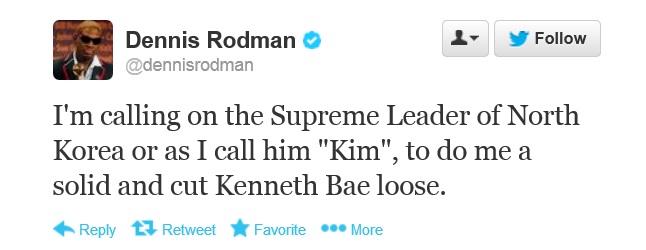
When Dennis Rodman, the former NBA rebound champ, tweeted, on May 7th, 2013:


dennis-rodman-tweet

His upcoming visit to North Korea in August 2013 seemed positive. Bae is an American missionary arrested in late 2012 in North Korea and sentenced to 15 years in early 2013 for crimes against the state. Loaded with confidence, Rodman even criticized President Obama and added, “Obama can’t do s**t, I don’t know why he [Obama] won’t go talk to him [Kim].”


“The Worm” called his upcoming visit in August a “basketball diplomacy tour,” suggesting that his method is in full effect and will revolutionize diplomatic relationship with international “loose cannon,” the Democratic People’s Republic of Korea.


However, Rodman’s comments – followed by his visit, not in August, but instead in September – precipitated doubts about his basketball diplomacy. Rodman’s response to the reporters in Beijing before crossing over to the North perplexed those who had hoped for a different answer. When asked about discussing Bae’s release with Kim Jong-un, Rodman commented, “I’m not going to talk about that,” and added, “Guess what? That’s not my job to ask about Kenneth Bae. Ask Obama about that. Ask Hillary Clinton.” These comments seemed to uncover Rodman’s guise of a “diplomatic” attitude.


Some still remained hopeful, however. Reverend Jesse Jackson Sr., a civil rights and religious activist, tweeted, “Congrads [sic] @dennisrodman on your diplomacy efforts in North Korea. It might be dark but you are a light!” This was deleted and replaced by, “… ping pong diplomacy worked in China, and Basketball seems to work in North Korea. #KeepHopeAlive”, referring to the method used in the early 1970s by Nixon’s administration to open up and build ties with the People’s Republic of China.


Kudos to Reverend Jackson for digging out a similar negotiation strategy from the past, but there’s a “minor” error in his comparison of the two: when Tim Boggan, the American ping-pong champ, and the rest of the team visited the PRC, they represented the United State of America and cooperated with the U.S. government to advance U.S.-PRC relations.


Unlike Boggan, when Dennis Rodman visited North Korea again on January 9, 2014, he’d become “BFFs” (best friends forever), with the young North Korean leader, the friendship struck when the two sat next to each other watching a basketball exhibition in Pyongyang in February 2013.


But when asked, Rodman had no interest of resolving Bae’s internment. Even worse, he sided with the North and brashly asked the press if they knew what Bae had done, implying that maybe Bae deserved his sentence. In turn, the U.S. responded to his actions by stating that Rodman was not a representative; Bill Richardson, a former U.S. ambassador to the United Nations who visited North Korea, followed up with this criticism and said Rodman’s comments “crossed the line.”


Rodman’s comments confirmed that as far as opinions on Bae’s captivity or Kim Jong-un go, he and the U.S. aren’t on the same page. He defended his visit: it was about opening “the door a little bit”, and indeed, taking the steps gradually may be the key. However, this January’s trip was his fourth to North Korea, and every time, he seems to be buddying up to Kim at the expense of becoming an enemy of the States. He’s no longer working towards “basketball diplomacy”, but rather, too busy entertaining Kim for the leader’s birthday.


Despite what many had hoped for, it appears that a leopard can’t change his spots. Rodman failed his own self-appointed diplomatic mission, his nation, and those who truly work for democracy and transparency.