Showing posts with label politics. Show all posts

Wednesday, May 7, 2014

Making Sense of the Recent Attacks in China

There have been three assaults on civilians in China in the past three months, the last two having occurred within a week of each other. The Chinese government has labeled these incidents terrorist attacks.


stabbing-china-separatist-map

Photo: The Guardian


The most recent killing involved an assailant who stabbed six people on May 6 at a railway station in the southern city of Guangzhou. There were no fatalities, but the six victims were injured and the suspect was shot and wounded by Chinese police.


The violence occurred less than a week after three were killed and 79 injured in a knife and bomb attack at the railway station in Urumqi, the capital of the northwestern region of Xinjiang.


However, the government first became alarmed in March when five attackers with knives and machetes killed 29 and injured more than 140 at a station in the southwestern city of Kunming.


Twenty-nine people were killed in a knife attack at Kunming rail station, southwest China, in early March. More than 140 others were injured when assailants, thought to be Xinjiang separatists from the west, began hacking at people apparently at random. Four attackers were shot dead by police at the scene.


Officials have blamed the incidents in Urumqi and Kunming on separatist terrorists from Xinjiang. It is suspected that the region’s Uighur minority is unhappy with the regulation and seeks to form an independent state, East Turkestan. While the most recent attack has not been officially linked to the earlier two, it is highly suspected they are related.


Before the attack in Guangzhou, President Xi Jinping had travelled to Xinjiang to address the ongoing issue of violence. There he announced plans to arm Chinese police officers with guns. He said that as China’s westernmost border region, the city of Kashgar in Xinjiang is at the frontline in the fight against terrorism. Furthermore, he ordered the army to help local government deliver a “crushing blow” to terrorists.


However, Xi’s visit also involved visiting a mosque and directly addressing the issue of religion in the region. This could be seen as more indirect measures of dealing with the issue because the ongoing violence has been associated with the Turkic Uighur Muslim population of Xinjiang.


Xi visited a 120-year-old mosque and sat with a group of religious leaders and listened to their views about regional issues. He made a comment that maintained his view that religion needs to adapt to social developments, but acknowledged that religious publications contain wisdom that can help guide people toward tolerance and acts of kindness.


These efforts are significant especially when considering China’s history with religious freedom and regional minorities. Nevertheless, the Chinese government will have to continue to find ways of preventing future violent events and protect its citizens.


Tuesday, April 29, 2014

Interpreting the World Bank’s Latest “East Asia and Pacific Economic Update”

The economic development in the East Asia Pacific region will continue to make other regions jealous this upcoming year. The region, however, still needs to be wary of changes in the global economic climate.


The World Bank announced April 7 that it projects continued stable economic growth for the East Asia Pacific region in 2014. The region is expected to remain the fastest growing in the world.


east-asia-pacific-map

The diverse countries and economies in the East Asia and Pacific region


Growth in the region, however, will be at a slightly lower rate. China’s growth rate will decrease from 7.7 percent in 2013 to 7.6 percent this year. The rest of the region will grow by 5.0 percent, down from 5.2 percent last year.


The World Bank also points out that economic climates are not equal throughout the region. Southeast Asian economies are more at risk, facing tougher global financial conditions and higher levels of household debt. Smaller economies are expected to grow steadily, but face overheating risks.


A garbage collector walks past residential and office buildings in construction, in Hefei

A garbage collector walks past residential and office buildings in construction, in Hefei, Anhui province

(Reuters)


Even the all-mighty China is not free from trouble. A slower-than-expected recovery of advanced economies, rise in global interest rates and increased volatility in commodity prices on account of the Crimean crisis are factors that could potentially hurt all of East Asia, according to Bert Hofman, Chief Economist of the World Bank’s East Asia and Pacific Region.


He recommends that East Asia redouble efforts to pursue structural reforms to increase their underlying growth potential and enhance market confidence. Such reforms are already taking place in China and are helping boost demand and growth. If done right, rebalancing could give boost to regional trade partners, but if the rebalancing is disorderly, the opposite could happen.


Possibly the most surprising feature of the report was its conclusions of 4 countries: Cambodia, Laos, Myanmar and Vietnam. Their exports have grown 19 percent annually, exceeding even China. These countries’ low wages, favorable demography and advantageous geography have been attractive enough to draw significant investments. While these are mostly in the textile industries, in the case of Vietnam, this has increasingly included electronics and telecommunications.


vietnam-plant-growth

Vietnam’s exports have shifted from clothing and textiles to electronics

(AP/Richard Vogel)


Despite its warnings of the instability of economic trends, the report was generally positive about the state of the economy of the East Asia Pacific region. It continues to be a region to watch because for its sustained growth.


The report did provide some explanation for the region’s success, but it was not nearly comprehensive enough. At a time when other regions struggle to keep up, it is important to monitor why and how this region has been able to have such sustained, successful growth.


Friday, April 18, 2014

Beyond Aung San Suu Kyi: Five Asian Female Leaders You May Not Know

For a long time, gender equality has been something the world has strived for. In the U.S., the fight for gender equality erupted during the Women’s Rights Movement more than a century and a half ago.


With that in mind, as well as the bad rap Asian countries often receive for female oppression (foot binding and geishas, anyone?), it may be a surprise to some that Asian countries seemed to have made more progress in terms of female leadership than Western countries. In fact, nine Asian countries (South Korea, Indonesia, India, Pakistan, Sri Lanka, Bangladesh, Thailand, the Philippines, and Mongolia) are currently or were led by a female, democratically elected head of government.


Needless to say, the U.S. has yet to have a female president.


While the reasons for this political difference give rise to a whole ‘nother article, in this one, I’d like to highlight a few of these – inspirational? controversial? certainly always interesting – Asian female leaders.


pratibha.patil


Pratibha Patil – 12th President of India (2007-2012)

Born in 1934, Patil had a long political career prior to becoming president, holding roles such as parliament member and governor. After winning the presidency with nearly 2/3 of the votes, her time in office saw a few controversies. For instance, she commuted the death sentences of 35 people, and embarked on more foreign trips than any other president.


corazon-aquino


Corazon Aquino – 11th President of the Philippines (1986-1992)

Born in 1933, Aquino was the first female president not only of the Philippines, but in all of Asia. Without holding any past political experience, she was the most prominent figure in the 1986 People Power Revolution and oversaw the promulgation of the 1987 Constitution. As president, she emphasized human rights and peaceful negotiations. Additionally, she focused on molding a market-oriented and healthy economy in the Philippines.


yingluck-shinawatra


Yingluck Shinawatra – 28th Prime Minister of Thailand

Born in 1967, Shinawatra is a businesswoman, politician, and the first (and current) Prime Minister of Thailand. After election to office in 2011, she invoked the Disaster Prevention and Mitigation Act in response to the 2011 Thailand floods; reshuffled her cabinet in 2012, and dissolved the Parliament, calling for early elections due to the 2013 anti-government protests. She is currently facing corruption investigations.


chandrika-kumaratunga


Chandrika Kumaratunga – 5th President of Sri Lanka

Born in 1945, Kumaratunga was elected Prime Minister of the People’s Alliance and was the leader of the Sri Lanka Freedom Party until 2006. She spent much of her presidency trying to negotiate and make peace with opposing national political parties. She is also a member of the Council of Women World Leaders.


sukarnoputri


Megawati Sukarnoputri – 5th President of Indonesia

Born in 1947, Sukarnoputri was the country’s only female president and is also leader of the Indonesian opposition party. While her presidency was characterized by slow progress, reforms, and resolutions, it also brought about the stabilization of democracy and more solid relationships amongst the legislative, executive, and military branches of government.


Monday, April 7, 2014

Asian-Americans and Local Residents Fight for More Affordable Housing in Boston’s Shrinking Chinatown

“Millennium Partners, pay your fees!”


“Jobs for our communities!”


During the Affordable Housing Parade on Sunday, March 30, a rainy day in Boston, Karen Chen, the 35-year-old Organizing Director of The Chinese Progressive Association, led the protest group in chants. A large sign, which read “We Can’t Afford Your Way of Life”, covered her upper body.


Boston-Protest-Affordable-Housing

Asian-Americans and local residents participate in a rally against the development of luxury housing in Boston’s Chinatown


Over 50 residents from Boston’s Chinatown and Roxbury and Dorchester, Masachusetts, gathered at the Downtown Crossing area to protest against Millennium Partners, a developer corporation now building its fourth luxury tower around Chinatown. They shook bottles as noisemakers, beat on white bucket for drums, and walked in a rally from Macy’s to Boston Common and back.


“Residents in at least ten buildings in Chinatown are facing risks of displacement due to the luxury development,” Chen said.


Boston-Chinatown-protest

Protesters braved the cold and the wet to rally against the development of luxury housing in Boston’s Chinatown


“Multi-million dollar developers should not be taking tax breaks to build luxury housing without creating higher wage jobs and meeting the city’s construction hiring and affordable housing goals,” Boston Jobs Coalition, co-organizers of the rally, said in a press release. “It’s time to stop using our tax dollars to line developers’ pockets while hard-working families are pushed out of their communities.”


As reported by the Boston Globe in December, 2013, Millennium Partners received a $5.9 million discount on development fees for the construction of luxury housing in Boston, allowed by the Boston Redevelopment Authority. “First, they received $19 million in historical preservation tax credit, then another $7.8 million on the city tax break,” explained Chen.


Boston-Protest-Affordable-Housing-Chinatown

Protesters wish to protect the community and to keep affordable housing for current residents and future generations


“I come to Chinatown mostly to go shopping and to eat Chinese food,” Patrick Tai, 68, said in the rally, “but now, quite a few of my favorite Chinese groceries and restaurants are disappearing because the neighborhood’s changing and they can’t afford to continue their business or to pay their rent.”


Since 1990, when the Community Master Plan, which limited the height of buildings around Chinatown, was repealed, the neighborhood has experienced an influx in luxury buildings. According to the Federal Reserve Bank of Cleveland, Boston has become the fastest gentrifying city in the country.


The Caucasian population in Boston and Philadelphia’s Chinatowns doubled between 2000 to 2010, although the entire Caucasian population of each city decreased, revealed the report Chinatown: Then and Now. “For many Asian-Americans, Chinatown is an essential part of our heritage and history. But Chinatowns on the East Coast are on the verge of disappearing.” The report was conducted by the Asian American Legal Defense and Education Fund and focused on the three biggest Chinatowns on the East Coast, in New York, Boston, and Philadelphia.


Regarding Philadelphia, the report said, “In 2009, residents defeated a proposal to build a 24-hour gambling casino less than two blocks from the first homes in Chinatown.” In New York, though the gentrification – a shift in an urban community to richer residents and increasing property values – is not as obvious as in Boston and Philadelphia, the city’s developers have converted many former factories into loft units selling for millions of dollars. Though the tenement buildings may retain the same exteriors, the landlords, who circumvent the City’s rent regulation laws, have increased the rent up to $3,000 per month. The steep rent has forced the original residents to move from their communities.


“I’m afraid that Chinatown would get smaller and smaller, and disappear one day. I don’t want that to happen,” Tai said.


All photographs courtesy of the author.


Tuesday, April 1, 2014

Protest Smart, Not Loud: Why Do We Protest?

It seems a simple enough question. We protest to demonstrate our displeasure. We protest to take democracy back into our own hands and show the world we mean business.


By definition, the word “protest” suggests that there is an object that is the recipient of our displeasure; in other words, to protest we must have something we are protesting. There is no protest for the sake of the protest alone (at least there shouldn’t be). I think we can all agree that a protest is an expression of popular opinion, which seeks to change something already in existence, and that I’ve already used that word way too many times in one paragraph.


Berkeley-rally-budget-cuts-Sproul-Hall

Sproul Hall Plaza at Berkeley, the site of many protests and rallies, past and present – to the extent that, in the 1960s, a journalist (Herbert Jacobs) developed a method for measuring crowd size from gridding protests at Sproul Hall


Humor aside, as a Berkeley student, I’m no stranger to protests. It’s part of the cultural identity of my university, one that distinguished us in the history of the United States and will continue to ripple through our legacy. We certainly have no shortage of things to protest. It seems like every semester brings another large-scale protest to the campus, over a variety of issues like tuition increases, perceived social injustices, unpopular UC officials, world affairs, and under-compensated graduate students. The list goes on. In the years that I’ve studied here, my attitude toward these protests frequently oscillates between pride and annoyance. I am proud because they are a crucial aspect of what makes Berkeley unique. They show how much our students care about the world around them and how people can make their voices heard.


I am annoyed because we often go about this in the wrong way.


It’s no secret that many things are settled in the court of popular opinion before they’re ever settled officially. Though there are many negative consequences to this, it’s an inevitable part of our society. When we protest in the wrong way, we turn the tide of popular opinion against us, not only failing to help our goals, but also invoking our dismissal as a legitimate voice. As I said above, we must have a purpose in order to protest. Without this purpose, a protest can degenerate into a collection of angry people shouting incoherently and achieving nothing. Then, a protest is no longer taken seriously and its chances of effecting change dramatically decreases.


If we protest, we need to be aware of who our target audience is. The ones who can affect the changes we want to see are the ones who should hear our protests. When protests disrupt the laypeople, instead of triggering empathy, it often triggers a backlash. This is why blocking the freeway is such an unsound demonstration strategy.


Now, why did I go into this rant about protests?


Though it’s been nearly 2 weeks, the protests in Taiwan seem to be only getting bigger. On Saturday, more than 100,000 Taiwanese protestors marched to Taipei, the capital of Taiwan, to demonstrate their anger over President Ma Ying-jeou’s trade deal with China. They fear that this deal would hurt Taiwan’s domestic businesses and allow for more Chinese influence in Taiwanese affairs. These started off as student movements, with hundreds of university students taking over Taiwan’s legislative building and camping out in the main assembly hall. Thousands more have since shown up in support.


Taiwanese Students Gather To Protest Against China Deal

Protest in Taipei on Saturday, March 30. The signs read 反黑箱 (fǎn hēixiāng), or “anti-black box“, meaning the protesters are against the opaque maneuvering of the Taiwanese government over the trade agreement with China


My fellow contributors on The Wang Post have also addressed this story, but I would like to use the “Sunflower Student Movement” to demonstrate my point in respect to the productivity of protests.


Though the demonstrations had generally been peaceful, violence broke out as protestors moved from the legislative into the executive building. The police responded by using force to remove them from the premises. This is where the protest went wrong.


The demonstrators have valid points. Their logic is easy to follow and it’s completely understandable why they would be upset. However, by effectively suspending the ability for the government to function productively, the protest has reached a point where the occupation itself might be harming the Taiwanese economy and its international economic credibility.


With a protest, it’s easy for passions to get riled up and for the group dynamic to lead to actions which go beyond its initial intentions. Certain ideas are contributory, but others can be damaging to the organized effort. This works on both sides. The Taiwanese government certainly isn’t doing itself any favors by using force to deal with the students, but neither are the protestors by venturing into disruptive territory.


Ultimately, it’s important to realize why we protest. If we want to affect change, we have to be smart about it. As the protest in Taiwan continues to gather steam, let’s hope it keeps this in mind.


Sunday, March 30, 2014

Photographs from the Student Protest in Taiwan

We are complicit in what’s become of 21st-century movements: protests, and even revolutions, are made with images.


It’s been a week since protesters of the now-called Sunflower Protest Movement who had occupied the Executive Yuan in Taipei were removed by the police, ending a nearly week-long demonstration against Taiwan’s signing of a trade pact with China. The pact, signed in July, will open up further trade in services between Taiwan and China, and critics say that it will hurt Taiwan’s local businesses and leave the country open to manipulations from China.


It probably didn’t help, with Russia’s “annex” of Crimea.


President Ma Ying-jeou and the ruling KMT have agreed to introduce a law that will monitor future trade agreements with China, but have refused to retract the signed trade pact as the protesters demand.


Here are some photographs from the protest in Taiwan over the weeks.


student-protesters-camp

Protesters camping out. The banner overhead reads (partly?), “Dad, Mom, don’t worry.”

(Photo: AFP)


taiwan-protest-piled-chairs

In the Executive Yuan, students pile chairs to build a temporary barrier

(Photo: Getty Images)


taiwan-protests-piled-obstacles

Fans block the stairway in the Executive Yuan

(Photo: Getty Images)


taiwan-parliament-protest


And – they’re in! A veritable Where’s Waldo – look at the yellow signs echoed in the sunflowers, the piled chairs, a fan saved from the stairs, the reporters working on their laptops along with conscientious trash collectors in the foreground, someone taking a nap?
(Photo: CNN)


taiwan-protest-police-clash-protesters

Police remove protesters from the Executive Yuan and from the streets


taiwan-protest-executive-yuan-cleared-students

Some of the images of police and protesters are disturbing

(Photo: AP)


taiwan-protest-sunflowers

Sunflowers have been used as a symbol by the protesters to shed “light” into the opaque government process.
The shirt worn by the man to the right translates to, “Our own country, we rescue ourselves.”
(Photo: Apple Daily)


Taiwan-anti-protest-rally

Although students and protesters are no longer occupying Executive Yuan, there are still anti-trade pact rallies. This one, though, was a protest against that:asking for the protesters to clear and the government to return to normal working schedules.
The cardboard sign? “With trade agreement, Taiwan has hope. Everyone approves. With trade agreement, the country has a future.”
(Photo: AP)


Tuesday, March 25, 2014

Is Another Cold War Brewing on the Horizon?

The Russian presence in Crimea seems to recall the Soviet Union’s post-World War II expansionism and the resulting era of global bipolarity, when the world seemingly fell under two divisive ideological banners. Although the communist regime has since collapsed and Russia no longer holds its status as the U.S.’s rival superpower, the current international situation strikingly parallels the historical atmosphere during the Cold War.


america-under-communism

Cold War propaganda


A brief history crash course:


The Cold War world was largely divided into two sides: the United States and its allies on one side and the Soviet Union and its allies on the other. This division was responsible for shaping the domestic politics of many developing nations, as well as the direction of global progress.


China was a key player in this schism. As a communist power, its allegiance was given to the Soviet Union, its neighbor to the North. However, as the relationship between Mao and Stalin disintegrated, so did the alliance between the People’s Republic of China and the Soviet Union. This eventually resulted in the Sino-Soviet split in 1961.


For the U.S., this situation was ripe with strategic opportunity; thus, the U.S. began courting China’s favor, which would make a big difference in the international balance of power. As regional relationships developed, this balance transformed into one of tripolarity, as one could no longer count on China (and its UN Security Council seat) to side with the USSR.


How is this related to what’s going on in Ukraine?


ukraine-russia-china-map

When talking geopolitics, it always helps me to see a map. Where is Crimea? It’s south of Ukraine, that drop of land in the Black Sea.


world-political-map

In a busy “big picture” perspective


Once again, Russia and the U.S. are at odds, with international attention focused on how China will respond to this controversy. Some have argued that Vladimir Putin’s annexation of Crimea is a move to return Russia back to its Cold War glory. It also appears that the PRC is once again stuck in the middle.


In recent years, the relationship between China and Russia had been strengthening since their Cold War antagonisms. The two neighbors have often taken the same side on a range of diplomatic issues. Chinese President Xi Jinping had made a state visit to Moscow in 2013, while Russian President Vladimir Putin had put forth the idea of a special relationship between the two powers. Furthermore, trade relations have been booming. It seems that China would support Putin’s actions.


Yet, the Russian Federation’s invasion goes against the international codes of national sovereign and territorial integrity, an issue on which China has always held a strong stance. Supporting this expansionist action would go against China’s record of advocating national sovereignty. Not only that, but supporting Crimean separatism could fuel China’s own separatist movements.


china-russia-crimea

Who is leading? It’s all perspective


Based on these factors, China’s decision on this issue could be highly indicative of the direction of its own political development. When China abstained from the UN Security Council vote on a Crimea resolution, it reflected the difficulty of their positioning. Some have taken this abstention as a marker of China’s condemnation of the Russian intervention in Ukraine. Some have interpreted this as a show of support. Others claim that this action should be taken for its face value: that China wants to refrain from taking any side.


It seems that now, much like it was during the Cold War, the question of which side China is on is extremely relevant to the future of international politics. More than that, China’s concerns are also highly self-reflective.


It’s no secret that territorial disputes and separatism are issues that have plagued the Chinese government for a long time. Particularly in regard to Taiwan and Tibet, China could undoubtedly see its own territorial issues reflected in the current international controversy surrounding the Crimean separation from Ukraine.


What happens next could indicate to China how similar actions on its part toward its own troubled territories would play out. In this case, perhaps it is best for China to refrain from any clear position on this issue. Knowing that Russia would inevitably veto the UN resolution on Crimea, perhaps it was wise for China to abstain.


Ultimately, how the Crimean crisis plays out could possibly give us a snapshot of Chinese policies going forward, and the future of the global balance of power.


Friday, February 21, 2014

A View on Chinese Politics, from a Chinese National

There are more than a dozen Chinese women in my college studying Chinese history and Politics, which have become a more and more popular subjects among Chinese overseas students. Once, I thought it absurd to study one’s national politics or literature in a foreign country, but my views has long been challenged since I came to the United States.


The prestigious Chinese scholar Qian Zhongshu once satirized the situation of Chinese people studying Chinese in American universities in his well-known novel Fortress Besieged (Wei Cheng/围城). Yet, the era of Dr. Qian’s bias on “American-wrought” Asian Studies majors is over: prominent studies have been done in the U.S. on Chinese literature, history, and politics. The college education offered in these subjects are very attractive to many Chinese students, who may be said to have advantage in their background, but who long for a new perspective of looking at their own cultures.


´òÓ¡

On the outside, looking in

(Vi Jia Designs)


In my Chinese Politics course, there were twenty people in the class, with four from China. The professor had asked each person to introduce him/herself and speak about why they were interested in studying Chinese politics. The American women, many of whom were taking Chinese language classes concurrently, talked about their passion in Eastern culture and their researching interests in the Chinese political environment. The Chinese women were the last to speak, partly due to shyness and partly due to “saving the best for last”.


Their opening sentences often were, “I was born and grew up in China, so I know a lot about…”, or “As a Chinese student, I’m very familiar with…” Their introductions were mini-lessons in themselves, overshadowing what was said a few minutes ago. They continued to speak about their interests – all very complicated, all very professional.


Please don’t misunderstand me: I’m not knocking or judging these Chinese students. They’re all smart and well-accomplished, and they’ve added many great topics to the discussion that we could never think of, otherwise. But, I didn’t end up talking at the end; suddenly, I felt like I didn’t have the confidence to talk about my interest in Chinese politics as a Chinese national. I don’t know as much as I’d thought.


Last week, I interviewed a professor studying African social history. She learned I was from China; she became excited and said, “I’ve just come back from a trip to Beijing!”


I grinned. “How was the air pollution there?”


“Actually, not as terrible as they’ve reported in the newspapers.”


(Yes; New York Times always selects the most striking pictures for the front page, so to attract views. It’s an old trick, but why don’t I question it so much when these photographs are about China?)


“Also,” the professor continued, “the subway wasn’t as bad as what I’ve read. And I don’t understand why they never mention that people in Beijing are so nice? American newspapers will criticize a foreign culture as long as it’s different from theirs, but they forget there are so many differences in the world.”


“What do you see in these differences?” I asked.


“I see similarities. I see that longing for a just society is a human trait.”


I was quiet for a while: I’ve been so judgmental to my own culture, paying so much attention to the negatives of China. Wasn’t I judging it by an “American standard”? What my professors, classmates, and friends have impressed me on was not just their knowledge about China, but their inclusive views. Compared to me, they hold such an optimistic opinion on Chinese democracy and enthusiasm for the culture. Their views may be a little idealized, but are more critical – daring to demand more, press for better – and less cynical then mine.


That day, I learned a new way to study Chinese politics and culture.


Friday, February 7, 2014

What It’s Like To Be The Only Asian-American Woman in the U.S. Senate

Senator Mazie Hirono has “first” all over her resume. A Democrat representing Hawaii, she is the first Asian-American woman elected to the United States Senate, the first female senator to represent her state, and the first Buddhist in the Senate. She’s also the first U.S. senator to have been born in Japan.


Hirono immigrated to Hawaii as a little girl because her mother was seeking stability for Mazie and her brother. The children’s father was an alcoholic and a compulsive gambler. They fled him and their homeland on the steerage deck of a cross-Pacific ship. Hirono remembers crying as Yokohama Harbor receded in the distance. She was eight and spoke only Japanese.


Life in Hawaii was a struggle at first. The family slept sideways in a shared bed in the single-room boarding house they rented. Hirono helped support her mother and brother with the money she earned as a cashier in the school lunchroom and with her earnings from an after-school newspaper route.


Eventually, she paid her way through college at the University of Hawaii and law school at Georgetown University. Hirono went on to become a state representative, Hawaii’s lieutenant governor, and a congresswoman. She was elected to the U.S. Senate in 2012.


I caught up with her about what it’s like to be a woman in the U.S. Senate, where inequality still persists, and what it took to get her where she is today. Here’s our conversation, lightly edited and condensed:


What’s your first memory from when you were a little girl of what you wanted to be when you grew up?


At a pretty young age, I wanted to do something with my life that would help people. I’ve been that way for quite a while. I wanted to be a counselor or social worker. That’s one of the reasons I was a psychology major.


How did watching your mother go through what she did affect the way you thought about women and what it takes for a woman to be in control of her own life?


I always saw my mother just making decisions that helped our family. It was much later when I realized how courageous she really was, and I came to understand what a risk-taker she was. That’s very much a part of how I am. I never took a path that was the usual path for someone in my generation. A lot of the women who I went to school with, in those days, it was still the track of becoming a teacher, becoming a nurse. Nothing wrong with that, of course, but I didn’t go down that path. I did things that were different than what my classmates were doing. I think that’s really from my mom.


Who else inspired you to do something other than what society expected?


No matter how independent you are, you’re still part of a larger community with sexual stereotyping and everything else that really goes on. The book that really opened my eyes — here I am in college, and that’s when I read Betty Friedan’s The Feminine Mystique. Even if I had such an unusual mother, so independent, I still — there was a part of me thinking, ‘Well, I’m gonna get married and I’m gonna have kids.’


And then I read that book, and literally a lightbulb went on in my head: ‘Why am I thinking this? I’ve never had a male presence in my life, really, so why do I think some guy is going to come along and I’m going to have this traditional life?’ It was at that point I think that I really began to look at my life as something that was probably going to take a different path, and it did.


Hirono and husband Leighton Oshima at the White House Bowling Alley, 2012


There were fewer women in law school during your time at Georgetown. What was that experience like?


Oh, yes. There were maybe 20 percent or fewer. I don’t know that I saw that much of a distinction by the time I was in law school. Definitely, there weren’t 50 percent [women], but at that point, at Georgetown, you’re competing with everyone else. It was a very competitive environment. I wanted to do public interest law. And the reason I selected Georgetown is they had really strong clinical programs, and I was in one of these clinical programs that involved being an advocate.


Fast-forward to being in Congress. Obviously we get more women with each election, which is great.


Yes. It’s really great.


But I’m still curious about some of the nuances — even if it’s something as seemingly small as the women’s bathroom being farther away from the floor.


You should see how it was on the House side. It’s much closer on the Senate side.


What are some of the other things you notice that are different for a woman than for a man, things that people who aren’t in Congress might not be privy to?


I’m pausing because every senator makes a huge difference. Regardless of whether you’re male, female, Republican, or Democrat, every Senate vote counts. From that standpoint, it’s not necessarily something that is a gender issue.


Right. So where it matters most, you’re truly equal.


But clearly, though, with the press, they seem to be really interested in the women of the Senate and when we don’t seem to agree on a path. I’m specifically talking about sexual assault in the military. [New York Democratic Sen.] Kirsten Gillibrand and I — and others — have supported a pretty significant change to the Code of Military Justice. [Missouri Democratic Sen.] Claire McCaskill has a different path. But we all agree that sexual assault in the military should be prevented and there should be prosecutions when these crimes occur. But there’s been a lot of press about why it is that we’re not together. I don’t think that’s an issue very much when men disagree.


It’s a very specific example of how the press still looks at our presence in this environment.


Years ago I found a 1950s article at the Library of Congress about [former congresswoman and Title IX author] Patsy Mink. The lede was something like, ‘the cutest politician you ever saw.’ So, on one hand, you think how far we’ve come, but then you still see coverage that references women leaders’ haircuts and outfits.


Or how petite we are. That sort of thing. You notice that a lot more still with women.


Hillary Clinton and Mazie Hirono


You’re a woman in a legislative body full of men, and you’re also the first Asian-American woman in the Senate. Are you treated differently for one more than for the other?


My being the only [Asian-American] woman here and only the second minority woman ever to be elected to the Senate, I think that says we have a ways to go. When I go home, I talk with the kids in Hawaii and I say, ‘Do you know there’s only one person in the Senate who looks like us?’


They must be shocked. [Ed. note: Asians make up 38 percent of the Hawaii population ; 23 percent of the population identifies as two or more races.]


Yeah, when I put it that way. Because they look around and they see the cosmopolitan backgrounds that everybody has. And I say, ‘I am the only person who looks like us.’ And they invariably look at each other. And I say, ‘That’s why we need to do a lot more.’


So what advice do you give to young people — particularly young women — who aspire to public service or elected office?


We need to get everybody in the pipeline in the local races. The local political arena is where it started for me, and I think that is still the case, especially for women. We need to get a lot more women into the pipeline… in the political arena as well as in the private sector.


You see the Fortune 500 companies, you see the boards. [Ed. note: Less than 5 percent of Fortune 500 companies have women CEOs .] They have to pay attention, otherwise they are not going to get the kind of diversity that’s representative of our country.


How do you think women can better support each other? For instance, I’m not aspiring to be the CEO of a Fortune 500 company, but I still want to see more women in those roles. What can I do?


Well, awareness helps. And to feel that they make a difference.


Women in Hawaii, they need to vote. I definitely think that we can improve the voting rates of women in Hawaii. So, education and awareness.


I think it’s important for women to realize that their daughters, particularly, can aspire to a lot of different things — like robotics. The kids in Hawaii really like it and I’ve talked to kids from elementary school on up.


Especially the elementary and middle-school kids, I ask them, ‘If it weren’t for robotics, would you think about going into engineering?’ And they say no! So a lot of times, kids learn by doing. And then they realize, ‘Oh, I can do this.’ So those kinds of opportunities are really important, particularly for the girls.


This interview was originally published on Medium and is produced as part of The Only Woman in the Room collection by LadyBits .


Thursday, January 23, 2014

Folk Singer Turned First Lady: What It Means for China’s First Lady to Be on The Glamorous “Best-Dressed” List

When Xi Jinping assumed the role of President of China in March of 2013, it was amidst a cloud of uncertainty. The Chinese Communist Party was only just recovering from a public scandal involving a high-ranking member of the party, and there were a great deal of questions regarding how Xi planned to implement his goal of curbing corruption within the Party. On Xi’s first trip abroad however, accompanied by his wife, Peng Liyuan, foreign journalists were suddenly struck with another question: What is China’s First Lady wearing?


peng-liyuan-first-lady-fashion

Peng travels long-haul in style


Dressed in a long, dark, double-breasted trench coat, light blue scarf, black heels, and black leather handbag, her hair perfectly coiffed and in a bun, Peng stepped off the plane and into the limelight. The American press called her the next Michelle Obama, and her sartorial choices whipped fashionistas into a frenzy as they tried to guess the clothing label. The discovery that she’d chosen a domestic Chinese brand, Exception de Mixmind, as opposed to one of the major European fashion houses was hailed as a turning point for Chinese fashion. Vanity Fair included her in their Best-Dressed List of 2013, and domestic sales for Mixmind soared.


peng-liyuan-state-dinner

First Ladies Angélica Rivera de Peña (Mexico) and Peng Liyuan (China) navigate the stairs in high-heel pumps at a state dinner in Mexico City


From a Western perspective, the concept of a fashionable First Lady is nothing new, with notable examples being Jackie O., Carla Bruni, and, of course, Michelle Obama. But in China, where the First Lady has tended to stay out of the limelight, Peng’s position as a media darling has enormous potential for a government that was somewhat lacking in terms of charismatic international public figures. While no stranger to the role of the public figure – Peng previously garnered popularity within China as a folk singer – her position as the President’s wife has subjected her to a completely different level of exposure.


peng-liyuan-singer

Peng, performing in Beijing in 2012

(Photo: Imaginechina, via Agence France-Presse — Getty Images via NYT)


Peng’s coming out as China’s first publicly glamorous first lady comes at an interesting juncture in Chinese politics, especially given her husband’s position. Xi has been vocal in denouncing perceived excesses within the Party, and has vowed to crack down on these as a way of reducing corruption and streamlining the bureaucracy by launching a frugality campaign.


In this context, her choice of a homegrown label serves very much to bolster her husband’s position, and sets her apart from the wives of other politicians. In a time fraught with tension brought about by the rapidly increasing gap between rich and poor, as well as a flurry of political scandals involving bribery and corruption, brands like Louis Vuitton and Christian Dior are as much symbols of luxury and status as they are of corruption and excess.


peng-liyuan-fashions

Rivaling Kate Middleton and Michelle Obama


By imbuing the image that has become popularized in the West of what constitutes a “First Lady”, Peng makes herself more amenable to a global audience, which is especially crucial given her current status as a media darling, and her role as the President’s wife and as a face in contemporary Chinese politics. In redefining the roles of fashion within the Communist Party, and particularly in Peng’s choice to wear local Chinese brands, the question of style goes beyond the realm of individualized taste, and takes on a political dimension.


In adapting Western styles to Chinese brands within the current context, it may be possible for figures like Peng to redefine China’s image much like its fashion: as an accepted and legitimate part of the international community that still exists as its own distinctive entity.


Tuesday, January 21, 2014

All the President’s Women: The Public and Private Lives of Politicians

Political sex scandals are always irresistibly intriguing for exposing the profound darkness and secrecy hidden behind politely smiling professional faces. ABC has been successfully monetizing such fascination with Scandal, inspired by D.C. insider Judy Smith, who represented Monica Lewinsky during the Clinton-era scandal: its Season 3 premier had over 10 million viewers. Therefore, when French President François Hollande and his – not two, as everyone knew, but three – women, appeared on the scene, he also had vastly more than 10 million people watching.


A sex scandal is the last thing Hollande needs since he became the most unpopular French president on record in October 2013, with only a 26% approval rating. He’d lived unmarried with his partner Ségolène Royal, a fellow ambitious Socialist politician, for over 30 years. In June 2005, after Royal’s defeat in the French presidential election, the couple announced their separation. A few months later, a French website exposed details of Hollande’s long affair with journalist Valérie Trierweiler, who confirmed the relationship. In 2012, when Hollande won that year’s presidential election and moved into the Élysée Palace (the official residence of the French President), Trierweiler came along as the “First Girlfriend” and accompanied him to official events.


On January 10, 2014, the tabloid Closer exposed another scandal: the middle-aged French leader photographed riding a scooter with his bodyguard to meet with his gorgeous and supposed paramour, film actress and producer Julie Gayet. The dramatic twist is that Trierweiler was hospitalized several hours after she heard the shocking allegation. When Hollande visited her in the hospital, he neither confirmed nor denied the reports of his affair: his belief was that his personal life should not be scrutinized or judged.


Front cover of Closer magazine

“The secret love of the president”, Closer


The nebulous correlation between personal moral standards and political acumen got me thinking. Mao Zedong had three wives, with rumors of many other women on the side; yet, his accomplishments and contributions to China are not overshadowed at all – his personal life seemed negligible. Even if Mao abandoned his second wife He Zizhen (who accompanied him during the most arduous period of civil war, including the Long March) immediately after victory and married the elegant actress Jiang Qing, his marital status was never a focus of public discussion as Hollande’s is in France.


Compared to China’s strict censorship, which made Mao’s personal life beyond reproach, the French way of elevating such infidelities to an element of romantic style is more transparent. The national spirit to protect a politician’s privacy – think of Mitterrand and his second family – becomes the current politician’s excuse to hide every dirty, little secret, even when the leader of the country is supposed to be trustworthy and responsible.


hollande-women

Royal, Gayet, and Trierweiler


The way of crisis management and the consequences of such sex scandals hugely depend on the cultural background and values of the state. China has never had a “bachelor” leader due to influential and long-standing family values: the family is the fundamental unit of national stability and harmony. France, though, has a longer history of cohabitation and reputation of extramarital/sexual freedom. Despite being an unwed man with four children and a girlfriend acquired under nontraditional circumstances, Hollande was nevertheless elected; as well, his approval rating rose after the news of affair, especially among women. But really, the French has more on their plate than their President’s personal life – like the sluggish economy.


Former President Clinton’s statement, “I did not have sexual relations with that woman”, infuriated many simply because this sworn testimony was perjurious. For me, I believe that when one is telling the truth or what one truly believes in, how the general public understands him or her is no longer his or her fault.


Friday, January 17, 2014

You are What You Eat: Of Steamed Buns, Pizza, and Politicians

Food seems to be a popular political tool for politicians across the globe. Of course, the type of food is the crucial factor here: if one wants to convey that he stands with the people, as politicians are oft to do, he will choose a common food. When ordinary people see the public figure eating ordinary food, it makes the figure more relatable and representative. Apparently, this applies to Chinese politics as much as Western politics.


While New York Mayor Bill de Blasio undergoes scrutiny for his selection of utensils, the Chinese media and online forums exploded with admiration and praise for Chinese President Xi Jinping’s visit to a Beijing restaurant last month. During this surprise visit, Mr. Xi reportedly stood in line and paid for his own buns, reiterating his political platform as a “leader of the people”. In the Qingfeng Steamed Dumpling Shop, Mr. Xi ordered pork and onion buns, green vegetables, and pig intestines for roughly $3.40. Criticisms for the visit arose as well, though they were overwhelmed by the tide of positive response to this rare demonstration of populism.


president-xi-china-buns

President Xi enjoying an everyman’s lunch


While American politicians commonly frequent popular local establishments in campaign events, this type of PR strategy is few and far between in China. With a long history of institutionalized separation between the masses and those in power, modern Chinese perceptions of their inaccessible political leaders often fringe on the superhuman. For locals, President Xi’s visit instantly canonized his order, with the dishes and the Beijing eatery becoming popular subjects for tourism.


Last week, Mayor Bill de Blasio had markedly different reactions from his recent restaurant visit. The new mayor of New York City was seen eating pizza at the popular Staten Island eatery, Goodfella’s Pizza. Instead of starting a new pizza craze, the mayor’s lunch visit sparked an online and media controversy.


Common criticisms cite Mayor de Blasio’s use of a fork to eat his pizza as unrepresentative of the New York style. After the visit, Mayor de Blasio’s food selections aren’t the focus of the subsequent tourism – his cutlery is. The restaurant owner proceeded to put the fork on display, with plans to auction off the utensil at a charity fundraiser.


Daily-Show-Pizza-Jon-Stewart-bill-De-Blasio-Forkgate

Jon Stewart is on top of “Forkgate” with Mayor de Blasio

(Photo: Comedy Central)


It could be said that Mayor de Blasio’s gaffe derives in his “wrong” eating technique, one that was distinctively un-New York and not reflective of “the people,” while Mr. Xi adhered to common eating practices. Yet, a review of photos from the event revealed that Mr. Xi used chopsticks instead of his hands, which is the more common practice for Chinese people. Granted, politeness is a valid excuse for preferring one method to another, yet Mr. Xi encountered no criticisms of any kind over his choice of utensils.


For Mr. Xi, his lunch of steamed buns elevated the dish and the restaurant to a “presidential” level, while Mayor de Blasio was condemned for failing to adhere to the “ordinary” level. The differences in the reactions to Mr. Xi and Mayor de Blasio’s restaurant outings demonstrate fundamental differences in the sociopolitical conditions between China and the United States. Perhaps this shift in popular appeal marks a parallel shift in Chinese political norms. Mr. Xi’s bid to represent the Chinese people, or laobaixing, could be the beginning of a China that puts more weight on the opinions of her citizens, though this remains to be seen.


Main image by Tutou Jueren via China Digital Times


Thursday, January 16, 2014

The Red Guard and the Landlady

From cultural revolution to rent collection…


It’s always a pleasant surprise when my landlady drops by unannounced at eight in the morning. I’m familiar with the early bird rap tap on my door by now, and the first thing I do before opening the door is put on the kettle. Sometimes she’s there to collect the rent. Sometimes it’s to check the heating came on, or to write down the electricity meter digits, or to switch off the water supply to the roof so it doesn’t freeze in the pipes during winter, twiddling with hidden knobs under the kitchen sink.


This time, rap tap tap, it was just to have a chat. She had ambushed my downstairs neighbor while he was still in bed, to collect rent he hadn’t yet prepared, having just got back from a trip. He said to give him an hour or so to shower and wait for the bank to open. So she came up one floor to pass the time at mine, and have a natter. Sixty-four-year-old Beijing landladies tend to assume that everyone begins their day as early as they do.


I live in a dazayuan, or “miscellaneous courtyard”, in the hutongs, inside one of a myriad of doors tucked away behind the street entrance. Mine is on the third and top floor of a compact new building inside, which was knocked up in the summer of 2012, just before I moved in. I’ve written about my landlady before (Tales from the Hutong) and I like her. She’s friendly, trustworthy, and hasn’t hiked up the rent yet. In that respect, given some horror stories from Cuju bar just down the hutong, I’m lucky. She’s also relatively willing to talk about her life – and I’m by nature nosy.


I was still in my pajamas when she knocked (thick winter cottons, fortunately) and threw on a ratty dressing gown for decency’s sake. She stubbed out her cigarette in the narrow stairwell that connects up to the roof, and kicked off her sneakers before coming in. It wouldn’t do to get ash or dirt on her property.


The first thing which happens when my landlady visits, as I am well used to, is a short survey of what I’ve done with the place. A new shelf, a painting on the wall, different fish in the tank – any change is commented on with either “hao” (good) or “bu hao” (not good). No further explanation is offered, and her criteria for judgment are ever a mystery. This time she asked what the contraption behind the sofa was. I said it was a movie projector, and pointed at the blank wall opposite it. After a nerve-racking pause, she said “hao“.


Looking to fill the silence, which she was more comfortable in than I was, I showed her some photos of my family back in Oxford. As usual, we talked about my romantic prospects – she’s keen to see me settle down with a nice Chinese girl, and reminded me with a hand on my shoulder that it’s good to marry early, “or else when you’re old who will you have to give your money to?” I changed the topic and asked after her newest grandson, Chen Jiaming, who will be one next week and to whom I gave an English name (Jamie).


We talked about young Chinese today, something I’m always interested in hearing older generations on. “They haven’t eaten bitterness,” she replied, a familiar refrain. “They just think about eating, drinking, smoking, clothes.” The kids these days – if they weren’t kenlaozu (the “bite the old tribe”, living off their parents) they were yueguangzu, spending all their monthly wages. And then she started talking about her own youth.


red-guard-female

A Red Guard, China, circa 1967


Auntie Wang (as she likes me to call her) was born in the spring of 1949, and grew up together with the People’s Republic of China. Her family is from Jiangtai in northeast Beijing, an area which is now home to the fashionable 798 art district and the expensive Lido hotel. Back then, it was mostly farmland, and she helped her parents to plant and harvest wheat each year.


Her memories of those years were of hard times. Her family was very poor, she said, and could not afford enough wool for new clothes. She was pulled out of school during the famine of the Great Leap Forward (Auntie Wang is illiterate, as I had discovered to my embarrassment when we were first looking at our contract), and said she had very little to eat. When I ask further, she simply said, “Let’s not talk about it” (bie tile). As a teen, she joined the Red Guards and cut short her hair, which then reached her waist. She never grew it out again.


I asked Auntie what she did as a Red Guard. She waved vaguely in the direction of the hutongs to the south. “We struggled against landlords.” They would hang heavy wooden signs over the landlords’ necks, denoting them as capitalists, and make them take the “airplane” (feiji) position. That means body bent forwards from the waist at a right angle, arms back stiff and straight behind you, each hand clasping the other. Then… da si tamen. Beat them to death.


It was said in the same tone, with no special weight. If she saw the shock in my eyes, she didn’t let on. Auntie had all but directly admitted participating in murder, but to her it was just another part of the story of her life, told to pass the time while we waited. I didn’t say anything.


So she just went on. She remembered Zhou Enlai’s death, in January 1976, and how everyone cried. She remembered Mao Zedong’s death, nine months later, and how that was not so sad – the people, she said, remembered how poor they had been in those years, how his rule impacted their lives. The Cultural Revolution ended, and in 1978, at the age of 29, she married. She met her husband through a friend’s introduction – he was 35. The space I was living in was his, and when he died four years ago, she inherited it from him.


Now she was old, and forgetting things. The changes of the last decades were fast. Her two comments on China today were how expensive health care is, and that there are too many cars. In the evenings, she said, she couldn’t remember what she did that day. But the more distant past was still clear.


I saw an opening to make the obvious point. “The changes really are big,” I said. “Before, you were struggling against landlords. And now you’re a landlady…”


“No, I’m not,” Auntie said, simply. “I’m not a landlady, I just collect your rent.”


The thought was alien to her, rejected simply and with ease. She was a landlady, of course. I had seen her name on the property deed. But whenever I would hand her a fat envelope of rent cash, I had also felt her unease. I had figured it was because of prejudices against the landlord class ingrained during the Mao years. I had not thought through all that might have entailed.


We chatted some more, and then my neighbour knocked on the door, back from the bank. Auntie Wang put on her sneakers and went downstairs, telling me she would drop in again sometime with the rest of her family, to show me little Jamie. I said I would be sure to be up early, in case.


***


China is, of course, full of stories like this. Everyone over middle age has one. I find it difficult to connect the broader horrors of the Cultural Revolution as we read about it to those people, whether they were victims or perpetrators – and the line between the two, I suspect, is not so clear. I’m also fascinated by the collective amnesia that allows society to put such recent crime behind it and go on.


But the individual acts and their repercussions are still there in living memory. Just the other month, an eighty-year-old woman told me and a friend that she was sent to Sichuan for hard labor for ten years, along with her three sons, all because her husband was from a “bad family background”, with Qing dynasty officials in his bloodline. The author Yu Hua describes, in China in Ten Words, how as a schoolboy he and his vigilante classmates ambushed a young peasant who was illicitly selling food coupons, pushed him to the ground and hit him over the head with bricks until he was bloody.


I have so many questions for my landlady I didn’t ask, from somewhere between shyness and politeness. To face up to a past like that, whether out of trauma or shame or both, surely is unimaginably hard – let alone to a generation who has no understanding of those times, such as your children’s (and you certainly wouldn’t share it with a foreigner). Does her daughter know what she did? Will Jamie?


My distance from it all means there’s little comment I can give. I don’t feel I have the right to judge Auntie Wang, or rather that any sense of disapproval is muted, as if a dull banging behind heavy insulation. I still like her. What I do feel is ever deeper respect for Liu Boqin, a former Red Guard from Shandong province who apologized to his victims in a Chinese magazine last summer. He named nine people in particular, some of whom he has tracked down to apologize to in person. He’s in his early sixties, so like Auntie, he was in his teens during those years. Here’s what he wrote:


“I want to apologize to all victims and their families to obtain psychological relief. An open letter is simple and clear. [...] I was naive, easily bamboozled, and never distinguished good from bad. [...] As I grow older, I have a more profound understanding of the sins of the Cultural Revolution. I cannot forget what I’ve done wrong.”


*


Another, more recent apology from the Cultural Revolution, from someone higher up, here (in NYT, so behind the wall). For a personal perspective of what those early years were like I can’t recommend highly enough Red Guard: The Political Biography of Dai Hsiao-Ai (hat tip to Rana Mitter) as a blow-by-blow account – so to speak – from someone in the thick of it, rather than the broad brush strokes of history books.


This story originally appeared on the Anthill.


Monday, January 13, 2014

The Failure of Rodman’s “Basketball Diplomacy”

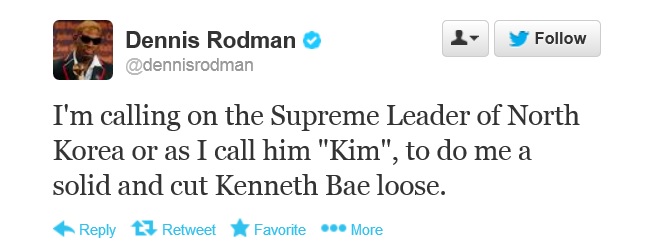
When Dennis Rodman, the former NBA rebound champ, tweeted, on May 7th, 2013:


dennis-rodman-tweet

His upcoming visit to North Korea in August 2013 seemed positive. Bae is an American missionary arrested in late 2012 in North Korea and sentenced to 15 years in early 2013 for crimes against the state. Loaded with confidence, Rodman even criticized President Obama and added, “Obama can’t do s**t, I don’t know why he [Obama] won’t go talk to him [Kim].”

“The Worm” called his upcoming visit in August a “basketball diplomacy tour,” suggesting that his method is in full effect and will revolutionize diplomatic relationship with international “loose cannon,” the Democratic People’s Republic of Korea.


However, Rodman’s comments – followed by his visit, not in August, but instead in September – precipitated doubts about his basketball diplomacy. Rodman’s response to the reporters in Beijing before crossing over to the North perplexed those who had hoped for a different answer. When asked about discussing Bae’s release with Kim Jong-un, Rodman commented, “I’m not going to talk about that,” and added, “Guess what? That’s not my job to ask about Kenneth Bae. Ask Obama about that. Ask Hillary Clinton.” These comments seemed to uncover Rodman’s guise of a “diplomatic” attitude.


Some still remained hopeful, however. Reverend Jesse Jackson Sr., a civil rights and religious activist, tweeted, “Congrads [sic] @dennisrodman on your diplomacy efforts in North Korea. It might be dark but you are a light!” This was deleted and replaced by, “… ping pong diplomacy worked in China, and Basketball seems to work in North Korea. #KeepHopeAlive”, referring to the method used in the early 1970s by Nixon’s administration to open up and build ties with the People’s Republic of China.


Kudos to Reverend Jackson for digging out a similar negotiation strategy from the past, but there’s a “minor” error in his comparison of the two: when Tim Boggan, the American ping-pong champ, and the rest of the team visited the PRC, they represented the United State of America and cooperated with the U.S. government to advance U.S.-PRC relations.


Unlike Boggan, when Dennis Rodman visited North Korea again on January 9, 2014, he’d become “BFFs” (best friends forever), with the young North Korean leader, the friendship struck when the two sat next to each other watching a basketball exhibition in Pyongyang in February 2013.


But when asked, Rodman had no interest of resolving Bae’s internment. Even worse, he sided with the North and brashly asked the press if they knew what Bae had done, implying that maybe Bae deserved his sentence. In turn, the U.S. responded to his actions by stating that Rodman was not a representative; Bill Richardson, a former U.S. ambassador to the United Nations who visited North Korea, followed up with this criticism and said Rodman’s comments “crossed the line.”


Rodman’s comments confirmed that as far as opinions on Bae’s captivity or Kim Jong-un go, he and the U.S. aren’t on the same page. He defended his visit: it was about opening “the door a little bit”, and indeed, taking the steps gradually may be the key. However, this January’s trip was his fourth to North Korea, and every time, he seems to be buddying up to Kim at the expense of becoming an enemy of the States. He’s no longer working towards “basketball diplomacy”, but rather, too busy entertaining Kim for the leader’s birthday.


Despite what many had hoped for, it appears that a leopard can’t change his spots. Rodman failed his own self-appointed diplomatic mission, his nation, and those who truly work for democracy and transparency.


Saturday, December 21, 2013

Saturday Quickie: What’s in My Browser Cache

In which we collect news and stories of interest from the internet, so you can sit on the couch and pretend to “work” on your laptop versus cleaning up or helping out in the kitchen. Wait, that’s me.


AAPI(ish)


In China, bird flu is back in the news. (Voice of America)

For a local’s take, TWP covered it here.


San Francisco had a day of air quality worse than Beijing, and then everyone was all like, APPLES AND ORANGES. (SFist)


Murder on the Roof of the World: My Travels Along the China-Pakistan Border (The Atlantic)


Writer Li Chenpeng praises Taiwanese democracy, sees trees for forest? (Li’s Sina blog, in Chinese)


And beyond


15 scary, beautiful scenes of skeletons (Salon)


This seemed to be a very social-services focused week for me: The Invisible Child (The New York Times), which will win something for sure, and The Welfare Queen (Slate)


Lose more time in the Wiki wormhole with the Wikipedia Advent Calendar. (Noah Veltman)