Showing posts with label News. Show all posts

Wednesday, June 18, 2014

Is Taiwanese Healthcare a Model to Emulate?

Healthcare. That word in the United States draws controversy from all sides of the spectrum. Our nation’s healthcare reform debate is an ongoing political issue, as the United States is still the only industrialized democracy without universal health insurance.


the-doctor-is-in-peanuts-charlie-brown-healthcare


Imagine a small island nation over seven thousand miles away. Here, residents may visit a clinic down the street and meet with a doctor they haven’t seen before, without scheduling an appointment. When meeting with the physician, they present a medical card that contains a chip with all their medical records. The doctor has immediate access to these patients’ medical history, any drugs they are taking, and other important health information.


Though quite different from what we’re used to in the United States, the above scenario depicts the healthcare system in Taiwan. When I visited last summer and stayed with my cousin and his family, I had the chance to learn more about how the country’s health insurance system works. Since 1995, Taiwan, with 23 million residents, has had a universal healthcare system called the National Health Insurance (NHI). This form of socialized medical care allows Taiwanese citizens and residents to enjoy the benefits of a single-payer health insurance system.


My first week in Taipei, where my cousin lives, his three-year old daughter came down with a cold. On a Saturday morning, I tagged along with his wife and the child to the hospital.


What first caught my attention was how no appointment had to be made; another that struck me was how little time we had to wait at the clinic. Within a few minutes, a pediatrician escorted us to her office and my cousin-in-law handed her a medical card. My cousin’s daughter was given a checkup and rescribed some medicine. What also surprised me was that the medicine only cost 100 NT, which is just over US$3.


taiwan-the-hospital-drama

Why not: the actor Jerry Yan in The Hospital, a popular Taiwanese television drama


Though Taiwanese citizens have equal access to healthcare, the country spends only about 6.6% of its GDP on health expenditures, while the United States spends more than 17%. Residents of Taiwan pay a monthly fee for the NHI themselves, and their companies pay for a portion of the fee. The vast majority of patients and doctors in Taiwan are satisfied with this convenient and affordable system.


Of course, there are also costs to having unlimited access to healthcare. With a lack of funds, the Taiwanese government has had to borrow money from banks. Additionally, with the convenience of healthcare, there is a large number of patients relying on too few doctors. When patients pay frequent visits to the doctor, it causes doctors to limit the amount of time each patient can be seen.


With a system that promises equal healthcare access, Taiwanese residents take care of each other. In the United States, healthcare is seen more as the responsibility of an individual. Perhaps these two nations’ different systems stem from this cultural disparity.


Wednesday, May 7, 2014

Making Sense of the Recent Attacks in China

There have been three assaults on civilians in China in the past three months, the last two having occurred within a week of each other. The Chinese government has labeled these incidents terrorist attacks.


stabbing-china-separatist-map

Photo: The Guardian


The most recent killing involved an assailant who stabbed six people on May 6 at a railway station in the southern city of Guangzhou. There were no fatalities, but the six victims were injured and the suspect was shot and wounded by Chinese police.


The violence occurred less than a week after three were killed and 79 injured in a knife and bomb attack at the railway station in Urumqi, the capital of the northwestern region of Xinjiang.


However, the government first became alarmed in March when five attackers with knives and machetes killed 29 and injured more than 140 at a station in the southwestern city of Kunming.


Twenty-nine people were killed in a knife attack at Kunming rail station, southwest China, in early March. More than 140 others were injured when assailants, thought to be Xinjiang separatists from the west, began hacking at people apparently at random. Four attackers were shot dead by police at the scene.


Officials have blamed the incidents in Urumqi and Kunming on separatist terrorists from Xinjiang. It is suspected that the region’s Uighur minority is unhappy with the regulation and seeks to form an independent state, East Turkestan. While the most recent attack has not been officially linked to the earlier two, it is highly suspected they are related.


Before the attack in Guangzhou, President Xi Jinping had travelled to Xinjiang to address the ongoing issue of violence. There he announced plans to arm Chinese police officers with guns. He said that as China’s westernmost border region, the city of Kashgar in Xinjiang is at the frontline in the fight against terrorism. Furthermore, he ordered the army to help local government deliver a “crushing blow” to terrorists.


However, Xi’s visit also involved visiting a mosque and directly addressing the issue of religion in the region. This could be seen as more indirect measures of dealing with the issue because the ongoing violence has been associated with the Turkic Uighur Muslim population of Xinjiang.


Xi visited a 120-year-old mosque and sat with a group of religious leaders and listened to their views about regional issues. He made a comment that maintained his view that religion needs to adapt to social developments, but acknowledged that religious publications contain wisdom that can help guide people toward tolerance and acts of kindness.


These efforts are significant especially when considering China’s history with religious freedom and regional minorities. Nevertheless, the Chinese government will have to continue to find ways of preventing future violent events and protect its citizens.


Monday, April 7, 2014

Asian-Americans and Local Residents Fight for More Affordable Housing in Boston’s Shrinking Chinatown

“Millennium Partners, pay your fees!”


“Jobs for our communities!”


During the Affordable Housing Parade on Sunday, March 30, a rainy day in Boston, Karen Chen, the 35-year-old Organizing Director of The Chinese Progressive Association, led the protest group in chants. A large sign, which read “We Can’t Afford Your Way of Life”, covered her upper body.


Boston-Protest-Affordable-Housing

Asian-Americans and local residents participate in a rally against the development of luxury housing in Boston’s Chinatown


Over 50 residents from Boston’s Chinatown and Roxbury and Dorchester, Masachusetts, gathered at the Downtown Crossing area to protest against Millennium Partners, a developer corporation now building its fourth luxury tower around Chinatown. They shook bottles as noisemakers, beat on white bucket for drums, and walked in a rally from Macy’s to Boston Common and back.


“Residents in at least ten buildings in Chinatown are facing risks of displacement due to the luxury development,” Chen said.


Boston-Chinatown-protest

Protesters braved the cold and the wet to rally against the development of luxury housing in Boston’s Chinatown


“Multi-million dollar developers should not be taking tax breaks to build luxury housing without creating higher wage jobs and meeting the city’s construction hiring and affordable housing goals,” Boston Jobs Coalition, co-organizers of the rally, said in a press release. “It’s time to stop using our tax dollars to line developers’ pockets while hard-working families are pushed out of their communities.”


As reported by the Boston Globe in December, 2013, Millennium Partners received a $5.9 million discount on development fees for the construction of luxury housing in Boston, allowed by the Boston Redevelopment Authority. “First, they received $19 million in historical preservation tax credit, then another $7.8 million on the city tax break,” explained Chen.


Boston-Protest-Affordable-Housing-Chinatown

Protesters wish to protect the community and to keep affordable housing for current residents and future generations


“I come to Chinatown mostly to go shopping and to eat Chinese food,” Patrick Tai, 68, said in the rally, “but now, quite a few of my favorite Chinese groceries and restaurants are disappearing because the neighborhood’s changing and they can’t afford to continue their business or to pay their rent.”


Since 1990, when the Community Master Plan, which limited the height of buildings around Chinatown, was repealed, the neighborhood has experienced an influx in luxury buildings. According to the Federal Reserve Bank of Cleveland, Boston has become the fastest gentrifying city in the country.


The Caucasian population in Boston and Philadelphia’s Chinatowns doubled between 2000 to 2010, although the entire Caucasian population of each city decreased, revealed the report Chinatown: Then and Now. “For many Asian-Americans, Chinatown is an essential part of our heritage and history. But Chinatowns on the East Coast are on the verge of disappearing.” The report was conducted by the Asian American Legal Defense and Education Fund and focused on the three biggest Chinatowns on the East Coast, in New York, Boston, and Philadelphia.


Regarding Philadelphia, the report said, “In 2009, residents defeated a proposal to build a 24-hour gambling casino less than two blocks from the first homes in Chinatown.” In New York, though the gentrification – a shift in an urban community to richer residents and increasing property values – is not as obvious as in Boston and Philadelphia, the city’s developers have converted many former factories into loft units selling for millions of dollars. Though the tenement buildings may retain the same exteriors, the landlords, who circumvent the City’s rent regulation laws, have increased the rent up to $3,000 per month. The steep rent has forced the original residents to move from their communities.


“I’m afraid that Chinatown would get smaller and smaller, and disappear one day. I don’t want that to happen,” Tai said.


All photographs courtesy of the author.


Tuesday, April 1, 2014

Protest Smart, Not Loud: Why Do We Protest?

It seems a simple enough question. We protest to demonstrate our displeasure. We protest to take democracy back into our own hands and show the world we mean business.


By definition, the word “protest” suggests that there is an object that is the recipient of our displeasure; in other words, to protest we must have something we are protesting. There is no protest for the sake of the protest alone (at least there shouldn’t be). I think we can all agree that a protest is an expression of popular opinion, which seeks to change something already in existence, and that I’ve already used that word way too many times in one paragraph.


Berkeley-rally-budget-cuts-Sproul-Hall

Sproul Hall Plaza at Berkeley, the site of many protests and rallies, past and present – to the extent that, in the 1960s, a journalist (Herbert Jacobs) developed a method for measuring crowd size from gridding protests at Sproul Hall


Humor aside, as a Berkeley student, I’m no stranger to protests. It’s part of the cultural identity of my university, one that distinguished us in the history of the United States and will continue to ripple through our legacy. We certainly have no shortage of things to protest. It seems like every semester brings another large-scale protest to the campus, over a variety of issues like tuition increases, perceived social injustices, unpopular UC officials, world affairs, and under-compensated graduate students. The list goes on. In the years that I’ve studied here, my attitude toward these protests frequently oscillates between pride and annoyance. I am proud because they are a crucial aspect of what makes Berkeley unique. They show how much our students care about the world around them and how people can make their voices heard.


I am annoyed because we often go about this in the wrong way.


It’s no secret that many things are settled in the court of popular opinion before they’re ever settled officially. Though there are many negative consequences to this, it’s an inevitable part of our society. When we protest in the wrong way, we turn the tide of popular opinion against us, not only failing to help our goals, but also invoking our dismissal as a legitimate voice. As I said above, we must have a purpose in order to protest. Without this purpose, a protest can degenerate into a collection of angry people shouting incoherently and achieving nothing. Then, a protest is no longer taken seriously and its chances of effecting change dramatically decreases.


If we protest, we need to be aware of who our target audience is. The ones who can affect the changes we want to see are the ones who should hear our protests. When protests disrupt the laypeople, instead of triggering empathy, it often triggers a backlash. This is why blocking the freeway is such an unsound demonstration strategy.


Now, why did I go into this rant about protests?


Though it’s been nearly 2 weeks, the protests in Taiwan seem to be only getting bigger. On Saturday, more than 100,000 Taiwanese protestors marched to Taipei, the capital of Taiwan, to demonstrate their anger over President Ma Ying-jeou’s trade deal with China. They fear that this deal would hurt Taiwan’s domestic businesses and allow for more Chinese influence in Taiwanese affairs. These started off as student movements, with hundreds of university students taking over Taiwan’s legislative building and camping out in the main assembly hall. Thousands more have since shown up in support.


Taiwanese Students Gather To Protest Against China Deal

Protest in Taipei on Saturday, March 30. The signs read 反黑箱 (fǎn hēixiāng), or “anti-black box“, meaning the protesters are against the opaque maneuvering of the Taiwanese government over the trade agreement with China


My fellow contributors on The Wang Post have also addressed this story, but I would like to use the “Sunflower Student Movement” to demonstrate my point in respect to the productivity of protests.


Though the demonstrations had generally been peaceful, violence broke out as protestors moved from the legislative into the executive building. The police responded by using force to remove them from the premises. This is where the protest went wrong.


The demonstrators have valid points. Their logic is easy to follow and it’s completely understandable why they would be upset. However, by effectively suspending the ability for the government to function productively, the protest has reached a point where the occupation itself might be harming the Taiwanese economy and its international economic credibility.


With a protest, it’s easy for passions to get riled up and for the group dynamic to lead to actions which go beyond its initial intentions. Certain ideas are contributory, but others can be damaging to the organized effort. This works on both sides. The Taiwanese government certainly isn’t doing itself any favors by using force to deal with the students, but neither are the protestors by venturing into disruptive territory.


Ultimately, it’s important to realize why we protest. If we want to affect change, we have to be smart about it. As the protest in Taiwan continues to gather steam, let’s hope it keeps this in mind.


Sunday, March 30, 2014

Photographs from the Student Protest in Taiwan

We are complicit in what’s become of 21st-century movements: protests, and even revolutions, are made with images.


It’s been a week since protesters of the now-called Sunflower Protest Movement who had occupied the Executive Yuan in Taipei were removed by the police, ending a nearly week-long demonstration against Taiwan’s signing of a trade pact with China. The pact, signed in July, will open up further trade in services between Taiwan and China, and critics say that it will hurt Taiwan’s local businesses and leave the country open to manipulations from China.


It probably didn’t help, with Russia’s “annex” of Crimea.


President Ma Ying-jeou and the ruling KMT have agreed to introduce a law that will monitor future trade agreements with China, but have refused to retract the signed trade pact as the protesters demand.


Here are some photographs from the protest in Taiwan over the weeks.


student-protesters-camp

Protesters camping out. The banner overhead reads (partly?), “Dad, Mom, don’t worry.”

(Photo: AFP)


taiwan-protest-piled-chairs

In the Executive Yuan, students pile chairs to build a temporary barrier

(Photo: Getty Images)


taiwan-protests-piled-obstacles

Fans block the stairway in the Executive Yuan

(Photo: Getty Images)


taiwan-parliament-protest


And – they’re in! A veritable Where’s Waldo – look at the yellow signs echoed in the sunflowers, the piled chairs, a fan saved from the stairs, the reporters working on their laptops along with conscientious trash collectors in the foreground, someone taking a nap?
(Photo: CNN)


taiwan-protest-police-clash-protesters

Police remove protesters from the Executive Yuan and from the streets


taiwan-protest-executive-yuan-cleared-students

Some of the images of police and protesters are disturbing

(Photo: AP)


taiwan-protest-sunflowers

Sunflowers have been used as a symbol by the protesters to shed “light” into the opaque government process.
The shirt worn by the man to the right translates to, “Our own country, we rescue ourselves.”
(Photo: Apple Daily)


Taiwan-anti-protest-rally

Although students and protesters are no longer occupying Executive Yuan, there are still anti-trade pact rallies. This one, though, was a protest against that:asking for the protesters to clear and the government to return to normal working schedules.
The cardboard sign? “With trade agreement, Taiwan has hope. Everyone approves. With trade agreement, the country has a future.”
(Photo: AP)


Tuesday, March 25, 2014

Is Another Cold War Brewing on the Horizon?

The Russian presence in Crimea seems to recall the Soviet Union’s post-World War II expansionism and the resulting era of global bipolarity, when the world seemingly fell under two divisive ideological banners. Although the communist regime has since collapsed and Russia no longer holds its status as the U.S.’s rival superpower, the current international situation strikingly parallels the historical atmosphere during the Cold War.


america-under-communism

Cold War propaganda


A brief history crash course:


The Cold War world was largely divided into two sides: the United States and its allies on one side and the Soviet Union and its allies on the other. This division was responsible for shaping the domestic politics of many developing nations, as well as the direction of global progress.


China was a key player in this schism. As a communist power, its allegiance was given to the Soviet Union, its neighbor to the North. However, as the relationship between Mao and Stalin disintegrated, so did the alliance between the People’s Republic of China and the Soviet Union. This eventually resulted in the Sino-Soviet split in 1961.


For the U.S., this situation was ripe with strategic opportunity; thus, the U.S. began courting China’s favor, which would make a big difference in the international balance of power. As regional relationships developed, this balance transformed into one of tripolarity, as one could no longer count on China (and its UN Security Council seat) to side with the USSR.


How is this related to what’s going on in Ukraine?


ukraine-russia-china-map

When talking geopolitics, it always helps me to see a map. Where is Crimea? It’s south of Ukraine, that drop of land in the Black Sea.


world-political-map

In a busy “big picture” perspective


Once again, Russia and the U.S. are at odds, with international attention focused on how China will respond to this controversy. Some have argued that Vladimir Putin’s annexation of Crimea is a move to return Russia back to its Cold War glory. It also appears that the PRC is once again stuck in the middle.


In recent years, the relationship between China and Russia had been strengthening since their Cold War antagonisms. The two neighbors have often taken the same side on a range of diplomatic issues. Chinese President Xi Jinping had made a state visit to Moscow in 2013, while Russian President Vladimir Putin had put forth the idea of a special relationship between the two powers. Furthermore, trade relations have been booming. It seems that China would support Putin’s actions.


Yet, the Russian Federation’s invasion goes against the international codes of national sovereign and territorial integrity, an issue on which China has always held a strong stance. Supporting this expansionist action would go against China’s record of advocating national sovereignty. Not only that, but supporting Crimean separatism could fuel China’s own separatist movements.


china-russia-crimea

Who is leading? It’s all perspective


Based on these factors, China’s decision on this issue could be highly indicative of the direction of its own political development. When China abstained from the UN Security Council vote on a Crimea resolution, it reflected the difficulty of their positioning. Some have taken this abstention as a marker of China’s condemnation of the Russian intervention in Ukraine. Some have interpreted this as a show of support. Others claim that this action should be taken for its face value: that China wants to refrain from taking any side.


It seems that now, much like it was during the Cold War, the question of which side China is on is extremely relevant to the future of international politics. More than that, China’s concerns are also highly self-reflective.


It’s no secret that territorial disputes and separatism are issues that have plagued the Chinese government for a long time. Particularly in regard to Taiwan and Tibet, China could undoubtedly see its own territorial issues reflected in the current international controversy surrounding the Crimean separation from Ukraine.


What happens next could indicate to China how similar actions on its part toward its own troubled territories would play out. In this case, perhaps it is best for China to refrain from any clear position on this issue. Knowing that Russia would inevitably veto the UN resolution on Crimea, perhaps it was wise for China to abstain.


Ultimately, how the Crimean crisis plays out could possibly give us a snapshot of Chinese policies going forward, and the future of the global balance of power.


Friday, February 28, 2014

President Obama Meets with the Dalai Lama at the White House

On Friday, February 21st, President Barack Obama met with the 14th Dalai Lama in the Map Room of the White House, despite fervent protest from Beijing. This was not the first encounter between President Obama and the Dalai Lama, who already met twice: in February 2010 and July 2011. Both times, the Chinese government rebuked President Obama’s involvement in the Tibetan issue, claiming such meetings with the Dalai Lama gravely jeopardized Sino-America relations.


dalai-lama-snow

Dalai Lama tossing snow at reporters in D.C., 2010


Outside the People’s Republic of China, the 14th Dalai Lama is acknowledged as the exiled Tibetan spiritual leader. In 1951, after ratifying the Seventeen Point Agreement for the Peaceful Liberation of Tibet, the Dalai Lama worked briefly with the Chinese government; he was even elected as a delegate in the National People’s Congress and met Mao Zedong in Beijing. After the failure of the 1959 Tibetan Uprising, the Dalai Lama fled Potala Palace in Lhasa with his supporters for India, where he established the government of Tibet in exile in Dharamsala.


In recent years, many world leaders – the late Czech President Vaclav Havel, the President of the European Commission José Manuel Barroso, UK Prime Minister David Cameron, Belgian Prime Minister Guy Verhofsadt, German Chancellor Angela Merkel – have met with the Dalai Lama, all to angry opposition from Beijing.


Sometimes, the exchange of diplomatic disapprobation resulted in punishment: the Chinese government canceled the EU-China Summit planned in December 2008 in Lyon, France. The reason? Then-French President Nicolas Sarkozy’s meeting with the Dalai Lama in Poland at the 25th-anniversary commemoration of the Dalai Lama’s Nobel Peace Prize.


dalai-lama-bruni

The Dalai Lama with Carla Bruni, Sarkozy’s surprise of a third wife


France’s Foreign Minister Bernard Kouchner had rebuffed the warning of the Chinese government, saying that even “[France] cannot have foreign policies dictated, even by our friends.”


Compared to France’s approach, the White House’s attitude towards the Tibetan issue during the Friday meeting was more cautious and ambivalent. A carefully worded announcement read,


“The United States supports the Dalai Lama’s ‘middle way’ approach of neither assimilation nor independence for Tibetans in China. The United States recognizes Tibet to be a part of the People’s Republic of China and we do not support Tibetan independence. The United States strongly supports human rights and religious freedom in China.”


In response, the Chinese Foreign Ministry described the Dalai Lama as a “separatist” and claimed that the “‘middle way’ approach is deceptive, and in nature is a political guideline for ‘Tibet independence’, which the Chinese government will absolutely not tolerate.” Beijing interpreted President Obama’s encounter with Dalai Lama as a “gross interference” into Chinese internal affairs; pundits saw this as Washington’s reaction against China’s establishment of an Air Defense Identification Zone in the East China Sea, which escalated the already high tensions with Japan over disputed Senkaku/Diaoyu Islands.


China is a trading partner with many EU countries, and possess enormous holdings in the American market. With deepening Chinese-U.S. political and economic links, the White House managed – this time – to kept the meeting low-key (the event wasn’t even announced until Thursday) and to sidestep from the central Tibetan question by denouncing Tibetan independence. But every action demands a reaction – the issue, at this point, is still outstanding.


Thursday, January 23, 2014

Folk Singer Turned First Lady: What It Means for China’s First Lady to Be on The Glamorous “Best-Dressed” List

When Xi Jinping assumed the role of President of China in March of 2013, it was amidst a cloud of uncertainty. The Chinese Communist Party was only just recovering from a public scandal involving a high-ranking member of the party, and there were a great deal of questions regarding how Xi planned to implement his goal of curbing corruption within the Party. On Xi’s first trip abroad however, accompanied by his wife, Peng Liyuan, foreign journalists were suddenly struck with another question: What is China’s First Lady wearing?


peng-liyuan-first-lady-fashion

Peng travels long-haul in style


Dressed in a long, dark, double-breasted trench coat, light blue scarf, black heels, and black leather handbag, her hair perfectly coiffed and in a bun, Peng stepped off the plane and into the limelight. The American press called her the next Michelle Obama, and her sartorial choices whipped fashionistas into a frenzy as they tried to guess the clothing label. The discovery that she’d chosen a domestic Chinese brand, Exception de Mixmind, as opposed to one of the major European fashion houses was hailed as a turning point for Chinese fashion. Vanity Fair included her in their Best-Dressed List of 2013, and domestic sales for Mixmind soared.


peng-liyuan-state-dinner

First Ladies Angélica Rivera de Peña (Mexico) and Peng Liyuan (China) navigate the stairs in high-heel pumps at a state dinner in Mexico City


From a Western perspective, the concept of a fashionable First Lady is nothing new, with notable examples being Jackie O., Carla Bruni, and, of course, Michelle Obama. But in China, where the First Lady has tended to stay out of the limelight, Peng’s position as a media darling has enormous potential for a government that was somewhat lacking in terms of charismatic international public figures. While no stranger to the role of the public figure – Peng previously garnered popularity within China as a folk singer – her position as the President’s wife has subjected her to a completely different level of exposure.


peng-liyuan-singer

Peng, performing in Beijing in 2012

(Photo: Imaginechina, via Agence France-Presse — Getty Images via NYT)


Peng’s coming out as China’s first publicly glamorous first lady comes at an interesting juncture in Chinese politics, especially given her husband’s position. Xi has been vocal in denouncing perceived excesses within the Party, and has vowed to crack down on these as a way of reducing corruption and streamlining the bureaucracy by launching a frugality campaign.


In this context, her choice of a homegrown label serves very much to bolster her husband’s position, and sets her apart from the wives of other politicians. In a time fraught with tension brought about by the rapidly increasing gap between rich and poor, as well as a flurry of political scandals involving bribery and corruption, brands like Louis Vuitton and Christian Dior are as much symbols of luxury and status as they are of corruption and excess.


peng-liyuan-fashions

Rivaling Kate Middleton and Michelle Obama


By imbuing the image that has become popularized in the West of what constitutes a “First Lady”, Peng makes herself more amenable to a global audience, which is especially crucial given her current status as a media darling, and her role as the President’s wife and as a face in contemporary Chinese politics. In redefining the roles of fashion within the Communist Party, and particularly in Peng’s choice to wear local Chinese brands, the question of style goes beyond the realm of individualized taste, and takes on a political dimension.


In adapting Western styles to Chinese brands within the current context, it may be possible for figures like Peng to redefine China’s image much like its fashion: as an accepted and legitimate part of the international community that still exists as its own distinctive entity.


Tuesday, January 21, 2014

All the President’s Women: The Public and Private Lives of Politicians

Political sex scandals are always irresistibly intriguing for exposing the profound darkness and secrecy hidden behind politely smiling professional faces. ABC has been successfully monetizing such fascination with Scandal, inspired by D.C. insider Judy Smith, who represented Monica Lewinsky during the Clinton-era scandal: its Season 3 premier had over 10 million viewers. Therefore, when French President François Hollande and his – not two, as everyone knew, but three – women, appeared on the scene, he also had vastly more than 10 million people watching.


A sex scandal is the last thing Hollande needs since he became the most unpopular French president on record in October 2013, with only a 26% approval rating. He’d lived unmarried with his partner Ségolène Royal, a fellow ambitious Socialist politician, for over 30 years. In June 2005, after Royal’s defeat in the French presidential election, the couple announced their separation. A few months later, a French website exposed details of Hollande’s long affair with journalist Valérie Trierweiler, who confirmed the relationship. In 2012, when Hollande won that year’s presidential election and moved into the Élysée Palace (the official residence of the French President), Trierweiler came along as the “First Girlfriend” and accompanied him to official events.


On January 10, 2014, the tabloid Closer exposed another scandal: the middle-aged French leader photographed riding a scooter with his bodyguard to meet with his gorgeous and supposed paramour, film actress and producer Julie Gayet. The dramatic twist is that Trierweiler was hospitalized several hours after she heard the shocking allegation. When Hollande visited her in the hospital, he neither confirmed nor denied the reports of his affair: his belief was that his personal life should not be scrutinized or judged.


Front cover of Closer magazine

“The secret love of the president”, Closer


The nebulous correlation between personal moral standards and political acumen got me thinking. Mao Zedong had three wives, with rumors of many other women on the side; yet, his accomplishments and contributions to China are not overshadowed at all – his personal life seemed negligible. Even if Mao abandoned his second wife He Zizhen (who accompanied him during the most arduous period of civil war, including the Long March) immediately after victory and married the elegant actress Jiang Qing, his marital status was never a focus of public discussion as Hollande’s is in France.


Compared to China’s strict censorship, which made Mao’s personal life beyond reproach, the French way of elevating such infidelities to an element of romantic style is more transparent. The national spirit to protect a politician’s privacy – think of Mitterrand and his second family – becomes the current politician’s excuse to hide every dirty, little secret, even when the leader of the country is supposed to be trustworthy and responsible.


hollande-women

Royal, Gayet, and Trierweiler


The way of crisis management and the consequences of such sex scandals hugely depend on the cultural background and values of the state. China has never had a “bachelor” leader due to influential and long-standing family values: the family is the fundamental unit of national stability and harmony. France, though, has a longer history of cohabitation and reputation of extramarital/sexual freedom. Despite being an unwed man with four children and a girlfriend acquired under nontraditional circumstances, Hollande was nevertheless elected; as well, his approval rating rose after the news of affair, especially among women. But really, the French has more on their plate than their President’s personal life – like the sluggish economy.


Former President Clinton’s statement, “I did not have sexual relations with that woman”, infuriated many simply because this sworn testimony was perjurious. For me, I believe that when one is telling the truth or what one truly believes in, how the general public understands him or her is no longer his or her fault.


Friday, January 17, 2014

You are What You Eat: Of Steamed Buns, Pizza, and Politicians

Food seems to be a popular political tool for politicians across the globe. Of course, the type of food is the crucial factor here: if one wants to convey that he stands with the people, as politicians are oft to do, he will choose a common food. When ordinary people see the public figure eating ordinary food, it makes the figure more relatable and representative. Apparently, this applies to Chinese politics as much as Western politics.


While New York Mayor Bill de Blasio undergoes scrutiny for his selection of utensils, the Chinese media and online forums exploded with admiration and praise for Chinese President Xi Jinping’s visit to a Beijing restaurant last month. During this surprise visit, Mr. Xi reportedly stood in line and paid for his own buns, reiterating his political platform as a “leader of the people”. In the Qingfeng Steamed Dumpling Shop, Mr. Xi ordered pork and onion buns, green vegetables, and pig intestines for roughly $3.40. Criticisms for the visit arose as well, though they were overwhelmed by the tide of positive response to this rare demonstration of populism.


president-xi-china-buns

President Xi enjoying an everyman’s lunch


While American politicians commonly frequent popular local establishments in campaign events, this type of PR strategy is few and far between in China. With a long history of institutionalized separation between the masses and those in power, modern Chinese perceptions of their inaccessible political leaders often fringe on the superhuman. For locals, President Xi’s visit instantly canonized his order, with the dishes and the Beijing eatery becoming popular subjects for tourism.


Last week, Mayor Bill de Blasio had markedly different reactions from his recent restaurant visit. The new mayor of New York City was seen eating pizza at the popular Staten Island eatery, Goodfella’s Pizza. Instead of starting a new pizza craze, the mayor’s lunch visit sparked an online and media controversy.


Common criticisms cite Mayor de Blasio’s use of a fork to eat his pizza as unrepresentative of the New York style. After the visit, Mayor de Blasio’s food selections aren’t the focus of the subsequent tourism – his cutlery is. The restaurant owner proceeded to put the fork on display, with plans to auction off the utensil at a charity fundraiser.


Daily-Show-Pizza-Jon-Stewart-bill-De-Blasio-Forkgate

Jon Stewart is on top of “Forkgate” with Mayor de Blasio

(Photo: Comedy Central)


It could be said that Mayor de Blasio’s gaffe derives in his “wrong” eating technique, one that was distinctively un-New York and not reflective of “the people,” while Mr. Xi adhered to common eating practices. Yet, a review of photos from the event revealed that Mr. Xi used chopsticks instead of his hands, which is the more common practice for Chinese people. Granted, politeness is a valid excuse for preferring one method to another, yet Mr. Xi encountered no criticisms of any kind over his choice of utensils.


For Mr. Xi, his lunch of steamed buns elevated the dish and the restaurant to a “presidential” level, while Mayor de Blasio was condemned for failing to adhere to the “ordinary” level. The differences in the reactions to Mr. Xi and Mayor de Blasio’s restaurant outings demonstrate fundamental differences in the sociopolitical conditions between China and the United States. Perhaps this shift in popular appeal marks a parallel shift in Chinese political norms. Mr. Xi’s bid to represent the Chinese people, or laobaixing, could be the beginning of a China that puts more weight on the opinions of her citizens, though this remains to be seen.


Main image by Tutou Jueren via China Digital Times


Wednesday, January 15, 2014

The Invisible Culture War: Media Importation in China

Basically every BBC Sherlock fan knows that Season 2 is back. Fortunately, the Chinese audience were the first outside the U.K. to see the drama on Youku (the Chinese version of Youtube) only a few hours after its Wednesday night premiere.


Sherlock, a modern interpretation of Sir Arthur Conan Doyle’s influential detective short stories, fascinates millions of Chinese fans with its unique narrative complexity, incredibly charming yet obnoxious characters, and elaborate camerawork and animation.


Sherlock-Benedict-Cumberbatch

Benedict Cumberbatch as the fluffy-haired detective and Martin Freeman as the “What! How?” straight man


Having recognized the tremendous market potential for Sherlock Holmes, Youku Tudou purchased the license for more than a billion yuan (about US$165 million) in order to combat rampant internet piracy with their own high-quality and timely foreign media online broadcasts.


“The BBC will directly provide us with official Chinese language subtitles… which is a first for a British drama released over Youku Tudou,” Zhu Xiangyang, Youku Tudou’s Chief Content Executive, explained. “After a review process where the site’s internal team confirms there are no problems with the video or the subtitles, the episode can immediately be released, and the whole process takes about four hours only.”


Of course, there’s more to the story. From 2010 to 2013, the total amount of American dramas shown on Youku surged, maintaining the increasing rate of viewership at an exponential level. As the largest and most comprehensive Chinese online database of Western media, Youku Tudou monopolized licenses of 25 English-language dramas – viewership during the premiere of 2 Broke Girls’ Season 3 reached 4 million, while the number of people who tuned in for Agents of S.H.I.E.L.D. was 5 million.


For Chinese online video platforms, foreign dramas equal cash cows. After the State Administration of Radio Film and Television’s effective practice of wiping out online piracy, video websites seized the unprecedented opportunity of huge residual demand and built consumer loyalty by synchronizing more popular American and British dramas.


gossip_mao-1

Gossip Girls in China


Though the price of each episode has risen (from roughly $20,000 to $120,000 yuan) due to fierce competition between different websites, it’s still a drop compared to advertising revenue. Apart from the huge audience, English-language TV dramas also effectively “catch” the eyeballs of the particular consumer segment most desired by advertisers: a typical viewer is a white-collar or an undergraduate student, who is generally well-educated and occupies a relatively higher position on the social ladder. The cultural scheme of targeting the right consumer group proved successful – in 2010, the estimated total revenue generated by the media importation was 1 billion, with future prospects was even more promising.


Nevertheless, though the online market is welcoming, Chinese government has “globalphobic” policies regarding other mediums. Due to the strict content restrictions on television, currently no Chinese TV channels broadcast American television dramas or shows.


On one hand, the general public might not respond well to the unfamiliar lives of people living on another continent – after all, China itself is a gigantic country with a lot happening domestically. On the other hand, an attempt to import Desperate Housewives on CCTV-8 proved a hilarious failure due to weird Chinese dubbing and the scrubbing of all sexual or violent scenes – the plot didn’t make any sense after editing. As well, other Asian countries, such as Korea, have their respective cultural protectionist policies in place to avoid western cultural domination.


The gauntlet’s thrown and trodden upon: the invisible culture war’s already begun.


Main image via NPR


Monday, January 13, 2014

The Failure of Rodman’s “Basketball Diplomacy”

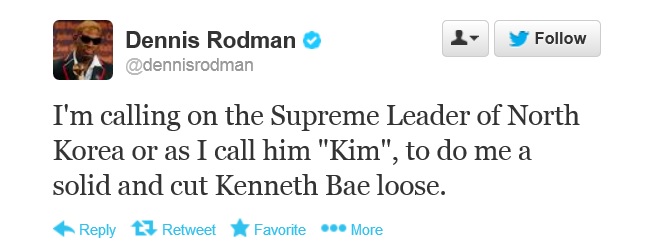
When Dennis Rodman, the former NBA rebound champ, tweeted, on May 7th, 2013:


dennis-rodman-tweet

His upcoming visit to North Korea in August 2013 seemed positive. Bae is an American missionary arrested in late 2012 in North Korea and sentenced to 15 years in early 2013 for crimes against the state. Loaded with confidence, Rodman even criticized President Obama and added, “Obama can’t do s**t, I don’t know why he [Obama] won’t go talk to him [Kim].”


“The Worm” called his upcoming visit in August a “basketball diplomacy tour,” suggesting that his method is in full effect and will revolutionize diplomatic relationship with international “loose cannon,” the Democratic People’s Republic of Korea.


However, Rodman’s comments – followed by his visit, not in August, but instead in September – precipitated doubts about his basketball diplomacy. Rodman’s response to the reporters in Beijing before crossing over to the North perplexed those who had hoped for a different answer. When asked about discussing Bae’s release with Kim Jong-un, Rodman commented, “I’m not going to talk about that,” and added, “Guess what? That’s not my job to ask about Kenneth Bae. Ask Obama about that. Ask Hillary Clinton.” These comments seemed to uncover Rodman’s guise of a “diplomatic” attitude.


Some still remained hopeful, however. Reverend Jesse Jackson Sr., a civil rights and religious activist, tweeted, “Congrads [sic] @dennisrodman on your diplomacy efforts in North Korea. It might be dark but you are a light!” This was deleted and replaced by, “… ping pong diplomacy worked in China, and Basketball seems to work in North Korea. #KeepHopeAlive”, referring to the method used in the early 1970s by Nixon’s administration to open up and build ties with the People’s Republic of China.


Kudos to Reverend Jackson for digging out a similar negotiation strategy from the past, but there’s a “minor” error in his comparison of the two: when Tim Boggan, the American ping-pong champ, and the rest of the team visited the PRC, they represented the United State of America and cooperated with the U.S. government to advance U.S.-PRC relations.


Unlike Boggan, when Dennis Rodman visited North Korea again on January 9, 2014, he’d become “BFFs” (best friends forever), with the young North Korean leader, the friendship struck when the two sat next to each other watching a basketball exhibition in Pyongyang in February 2013.


But when asked, Rodman had no interest of resolving Bae’s internment. Even worse, he sided with the North and brashly asked the press if they knew what Bae had done, implying that maybe Bae deserved his sentence. In turn, the U.S. responded to his actions by stating that Rodman was not a representative; Bill Richardson, a former U.S. ambassador to the United Nations who visited North Korea, followed up with this criticism and said Rodman’s comments “crossed the line.”


Rodman’s comments confirmed that as far as opinions on Bae’s captivity or Kim Jong-un go, he and the U.S. aren’t on the same page. He defended his visit: it was about opening “the door a little bit”, and indeed, taking the steps gradually may be the key. However, this January’s trip was his fourth to North Korea, and every time, he seems to be buddying up to Kim at the expense of becoming an enemy of the States. He’s no longer working towards “basketball diplomacy”, but rather, too busy entertaining Kim for the leader’s birthday.


Despite what many had hoped for, it appears that a leopard can’t change his spots. Rodman failed his own self-appointed diplomatic mission, his nation, and those who truly work for democracy and transparency.


Saturday, December 21, 2013

Saturday Quickie: What’s in My Browser Cache

In which we collect news and stories of interest from the internet, so you can sit on the couch and pretend to “work” on your laptop versus cleaning up or helping out in the kitchen. Wait, that’s me.


AAPI(ish)


In China, bird flu is back in the news. (Voice of America)

For a local’s take, TWP covered it here.


San Francisco had a day of air quality worse than Beijing, and then everyone was all like, APPLES AND ORANGES. (SFist)


Murder on the Roof of the World: My Travels Along the China-Pakistan Border (The Atlantic)


Writer Li Chenpeng praises Taiwanese democracy, sees trees for forest? (Li’s Sina blog, in Chinese)


And beyond


15 scary, beautiful scenes of skeletons (Salon)


This seemed to be a very social-services focused week for me: The Invisible Child (The New York Times), which will win something for sure, and The Welfare Queen (Slate)


Lose more time in the Wiki wormhole with the Wikipedia Advent Calendar. (Noah Veltman)