Showing posts with label Taiwan. Show all posts

Tuesday, August 5, 2014

An Invaluable Teaching Experience in Taiwan

Echoes of laughter, yelling, and heavy footsteps grow louder and louder as I approach the classroom. Taking a deep breath, I glance quickly at my lesson plans one last time and push open the door. As I step slowly into the room, I can feel the sudden stares of thirteen pairs of young eyes. Though many students are still out of their seats, with their arms playfully wrapped around each other and toys in their hands, the once raucous classroom immediately begins to quiet down. In the midst of all this, I ponder what to do next.


As another July passes by, I look back to the summer after my first year of college when I taught English to underprivileged elementary school children in rural southern Taiwan. Every day for two weeks, my teaching partner and I created a new lesson plan in which we incorporated activities we found most effective for teaching children. The experience was challenging at first because of the all-new environment and our language barrier. Our students’ knowledge of English was very limited, and my Mandarin speaking skills weren’t at a confident level.


teaching-english-in-asia-classroom


Before arriving in Taiwan, I thought teaching English would be very simple because it is my native language. After a few hours into the first day of class, however, I discovered that was not the case at all. Since I taught fourth to sixth grade students, their levels of English were all scattered. Some of them were not yet familiar with the alphabet while a lot of the older students already knew quite a few vocabulary words. Even so, my teaching partner and I tried our best to create a rewarding learning atmosphere. Whenever we saw our students getting bored with a certain activity, we would quickly try to come up with a new learning strategy. Whenever we noticed someone struggling to learn, we would take the initiative to get to know the student and find out the best way for him or her to grasp knowledge. We would experiment with different teaching methods, including games, songs, and dances, to help each individual learn while having fun. Prizes were a very effective way of getting students to participate in discussions and behave during class, as they were always excited to see what we had brought from America.


Something interesting I noticed at the school was how students there have such close relationships with their teachers. When I was teaching at the elementary school, I would stay after school every day and spend time with my students and a local teacher. This teacher would play basketball with the students for hours after English classes, listen to everything they had to say and take care of them as if they were his children. To his students, he was a friend, father, and teacher all in one.


That experience in Taiwan was definitely one of my best summer memories, and it sparked an interest in teaching. If there’s something I definitely would like to do in the future, it would be to visit my students again.


Wednesday, June 18, 2014

Is Taiwanese Healthcare a Model to Emulate?

Healthcare. That word in the United States draws controversy from all sides of the spectrum. Our nation’s healthcare reform debate is an ongoing political issue, as the United States is still the only industrialized democracy without universal health insurance.


the-doctor-is-in-peanuts-charlie-brown-healthcare


Imagine a small island nation over seven thousand miles away. Here, residents may visit a clinic down the street and meet with a doctor they haven’t seen before, without scheduling an appointment. When meeting with the physician, they present a medical card that contains a chip with all their medical records. The doctor has immediate access to these patients’ medical history, any drugs they are taking, and other important health information.


Though quite different from what we’re used to in the United States, the above scenario depicts the healthcare system in Taiwan. When I visited last summer and stayed with my cousin and his family, I had the chance to learn more about how the country’s health insurance system works. Since 1995, Taiwan, with 23 million residents, has had a universal healthcare system called the National Health Insurance (NHI). This form of socialized medical care allows Taiwanese citizens and residents to enjoy the benefits of a single-payer health insurance system.


My first week in Taipei, where my cousin lives, his three-year old daughter came down with a cold. On a Saturday morning, I tagged along with his wife and the child to the hospital.


What first caught my attention was how no appointment had to be made; another that struck me was how little time we had to wait at the clinic. Within a few minutes, a pediatrician escorted us to her office and my cousin-in-law handed her a medical card. My cousin’s daughter was given a checkup and rescribed some medicine. What also surprised me was that the medicine only cost 100 NT, which is just over US$3.


taiwan-the-hospital-drama

Why not: the actor Jerry Yan in The Hospital, a popular Taiwanese television drama


Though Taiwanese citizens have equal access to healthcare, the country spends only about 6.6% of its GDP on health expenditures, while the United States spends more than 17%. Residents of Taiwan pay a monthly fee for the NHI themselves, and their companies pay for a portion of the fee. The vast majority of patients and doctors in Taiwan are satisfied with this convenient and affordable system.


Of course, there are also costs to having unlimited access to healthcare. With a lack of funds, the Taiwanese government has had to borrow money from banks. Additionally, with the convenience of healthcare, there is a large number of patients relying on too few doctors. When patients pay frequent visits to the doctor, it causes doctors to limit the amount of time each patient can be seen.


With a system that promises equal healthcare access, Taiwanese residents take care of each other. In the United States, healthcare is seen more as the responsibility of an individual. Perhaps these two nations’ different systems stem from this cultural disparity.


Friday, June 6, 2014

A Taste of Taiwan: Four Not-to-Be-Missed Spots

On a sunny spring day, people stood in a queue to wait for a sizzling plate of oyster omelet: a savory dish of small oysters, egg batter, sauce, and green leafy vegetables. A few feet away at another small booth, a large group eagerly awaited a light snack of peanut brittle shavings, ice cream, and cilantro, in a thin burrito wrap. All around the festival site, people held colorful cups of bubble tea and aiyu jelly as they explore arts and crafts and watched exciting traditional dances.


Last week at Union Square in Manhattan, the 13th Annual Passport to Taiwan Festival celebrated Taiwanese-American heritage and introduced hundreds of people to the island nation’s brilliant culture, art, history, and mouthwatering food. That afternoon, I sipped on a boba drink while walking around the venue with a friend. We both spent last summer interning in Taipei, and the sights, food, music, and performances at the festival reminded us of our exciting adventures in Taiwan.


Here are four fun destinations in the nation’s capital that I really enjoyed last summer!


1. Chiang Kai-shek Memorial Hall (中正紀念堂/”Zhongzheng jinian tang”)


Chiang Kai-shek Memorial Hall-taipei-taiwan


The place I worked at last summer, the Ministry of Foreign Affairs, was right near this well-known monument erected in memory of the former president. During lunchtime, my colleagues and I would stroll to the large public square leading up to this memorial building and explore the area. Sometimes we’d watch the changing of the guard, which is an hourly ceremony conducted in a strict military fashion.


2. Yongkang Street (永康街/”Yongkang jie”)


yongkang-street-taipei-taiwan


Though I’ve been to Taipei a few times before, last year was the first time I visited this street, known for its famous restaurants, cafes, and small shops. While working at the Ministry, my coworkers and I would bike here to try out various delicacies: I really enjoyed Yongkang Street’s quaint noodle and dumpling restaurants and shaved ice booths.


3. Elephant Mountain (象山/”Xiangshan”)


elephant-mountain-taipei-taiwan


Hiking up stairs to reach the top of this mountain gives you a magnificent view of the Taipei skyline. It only takes about 20 minutes to get to the top, and the stairs aren’t too difficult to climb. The mountain is a particularly popular place to visit during sunrise and sunset, with tourists ascending alongside locals and photographers.


4. Ximending (西門町)


ximending-taipei-taiwan


This shopping district is famous for its youth culture and its restaurants, fashion-forward clothing shops, and all types of entertainment: theaters, salons, KTV venues, trendy bars and clubs, and food stalls. Ximending is always packed on weekends, with young people enjoying this happenin’ district.


There are abundant options of stores and places to eat, and you’ll find foreign restaurants in addition to unique eateries, including the infamous toilet-themed restaurant. Whether it’s seeing a live performance, getting a new haircut, or buying a snack, Ximending is an unforgettable must-see if you’re ever in Taipei.


Tuesday, April 1, 2014

Protest Smart, Not Loud: Why Do We Protest?

It seems a simple enough question. We protest to demonstrate our displeasure. We protest to take democracy back into our own hands and show the world we mean business.


By definition, the word “protest” suggests that there is an object that is the recipient of our displeasure; in other words, to protest we must have something we are protesting. There is no protest for the sake of the protest alone (at least there shouldn’t be). I think we can all agree that a protest is an expression of popular opinion, which seeks to change something already in existence, and that I’ve already used that word way too many times in one paragraph.


Berkeley-rally-budget-cuts-Sproul-Hall

Sproul Hall Plaza at Berkeley, the site of many protests and rallies, past and present – to the extent that, in the 1960s, a journalist (Herbert Jacobs) developed a method for measuring crowd size from gridding protests at Sproul Hall


Humor aside, as a Berkeley student, I’m no stranger to protests. It’s part of the cultural identity of my university, one that distinguished us in the history of the United States and will continue to ripple through our legacy. We certainly have no shortage of things to protest. It seems like every semester brings another large-scale protest to the campus, over a variety of issues like tuition increases, perceived social injustices, unpopular UC officials, world affairs, and under-compensated graduate students. The list goes on. In the years that I’ve studied here, my attitude toward these protests frequently oscillates between pride and annoyance. I am proud because they are a crucial aspect of what makes Berkeley unique. They show how much our students care about the world around them and how people can make their voices heard.


I am annoyed because we often go about this in the wrong way.


It’s no secret that many things are settled in the court of popular opinion before they’re ever settled officially. Though there are many negative consequences to this, it’s an inevitable part of our society. When we protest in the wrong way, we turn the tide of popular opinion against us, not only failing to help our goals, but also invoking our dismissal as a legitimate voice. As I said above, we must have a purpose in order to protest. Without this purpose, a protest can degenerate into a collection of angry people shouting incoherently and achieving nothing. Then, a protest is no longer taken seriously and its chances of effecting change dramatically decreases.


If we protest, we need to be aware of who our target audience is. The ones who can affect the changes we want to see are the ones who should hear our protests. When protests disrupt the laypeople, instead of triggering empathy, it often triggers a backlash. This is why blocking the freeway is such an unsound demonstration strategy.


Now, why did I go into this rant about protests?


Though it’s been nearly 2 weeks, the protests in Taiwan seem to be only getting bigger. On Saturday, more than 100,000 Taiwanese protestors marched to Taipei, the capital of Taiwan, to demonstrate their anger over President Ma Ying-jeou’s trade deal with China. They fear that this deal would hurt Taiwan’s domestic businesses and allow for more Chinese influence in Taiwanese affairs. These started off as student movements, with hundreds of university students taking over Taiwan’s legislative building and camping out in the main assembly hall. Thousands more have since shown up in support.


Taiwanese Students Gather To Protest Against China Deal

Protest in Taipei on Saturday, March 30. The signs read 反黑箱 (fǎn hēixiāng), or “anti-black box“, meaning the protesters are against the opaque maneuvering of the Taiwanese government over the trade agreement with China


My fellow contributors on The Wang Post have also addressed this story, but I would like to use the “Sunflower Student Movement” to demonstrate my point in respect to the productivity of protests.


Though the demonstrations had generally been peaceful, violence broke out as protestors moved from the legislative into the executive building. The police responded by using force to remove them from the premises. This is where the protest went wrong.


The demonstrators have valid points. Their logic is easy to follow and it’s completely understandable why they would be upset. However, by effectively suspending the ability for the government to function productively, the protest has reached a point where the occupation itself might be harming the Taiwanese economy and its international economic credibility.


With a protest, it’s easy for passions to get riled up and for the group dynamic to lead to actions which go beyond its initial intentions. Certain ideas are contributory, but others can be damaging to the organized effort. This works on both sides. The Taiwanese government certainly isn’t doing itself any favors by using force to deal with the students, but neither are the protestors by venturing into disruptive territory.


Ultimately, it’s important to realize why we protest. If we want to affect change, we have to be smart about it. As the protest in Taiwan continues to gather steam, let’s hope it keeps this in mind.


Sunday, March 30, 2014

Photographs from the Student Protest in Taiwan

We are complicit in what’s become of 21st-century movements: protests, and even revolutions, are made with images.


It’s been a week since protesters of the now-called Sunflower Protest Movement who had occupied the Executive Yuan in Taipei were removed by the police, ending a nearly week-long demonstration against Taiwan’s signing of a trade pact with China. The pact, signed in July, will open up further trade in services between Taiwan and China, and critics say that it will hurt Taiwan’s local businesses and leave the country open to manipulations from China.


It probably didn’t help, with Russia’s “annex” of Crimea.


President Ma Ying-jeou and the ruling KMT have agreed to introduce a law that will monitor future trade agreements with China, but have refused to retract the signed trade pact as the protesters demand.


Here are some photographs from the protest in Taiwan over the weeks.


student-protesters-camp

Protesters camping out. The banner overhead reads (partly?), “Dad, Mom, don’t worry.”

(Photo: AFP)


taiwan-protest-piled-chairs

In the Executive Yuan, students pile chairs to build a temporary barrier

(Photo: Getty Images)


taiwan-protests-piled-obstacles

Fans block the stairway in the Executive Yuan

(Photo: Getty Images)


taiwan-parliament-protest


And – they’re in! A veritable Where’s Waldo – look at the yellow signs echoed in the sunflowers, the piled chairs, a fan saved from the stairs, the reporters working on their laptops along with conscientious trash collectors in the foreground, someone taking a nap?
(Photo: CNN)


taiwan-protest-police-clash-protesters

Police remove protesters from the Executive Yuan and from the streets


taiwan-protest-executive-yuan-cleared-students

Some of the images of police and protesters are disturbing

(Photo: AP)


taiwan-protest-sunflowers

Sunflowers have been used as a symbol by the protesters to shed “light” into the opaque government process.
The shirt worn by the man to the right translates to, “Our own country, we rescue ourselves.”
(Photo: Apple Daily)


Taiwan-anti-protest-rally

Although students and protesters are no longer occupying Executive Yuan, there are still anti-trade pact rallies. This one, though, was a protest against that:asking for the protesters to clear and the government to return to normal working schedules.
The cardboard sign? “With trade agreement, Taiwan has hope. Everyone approves. With trade agreement, the country has a future.”
(Photo: AP)


Sunday, January 19, 2014

Two Weeks in Kinmen, Taiwan

The summer before college, I traveled to Taiwan to teach English to children in rural areas. While this was partly (okay, mostly) an excuse to return to the amazing country of Taiwan after nearly 6 years, I was also excited to learn that I would be teaching on Kinmen (金門, literally “golden gate”), a small island situated between Taiwan and southern China.


There is no way I can name everything I loved about my experience on Kinmen: the celebrity-esque airstairs we descended after landing amidst heavy tropical winds; our tiny, blessedly air-conditioned sleeping quarters where we hid from the suffocating humid heat that evaded every corner of the island; the famous Taiwanese oyster omelet dish (蚵仔煎) concocted with freshly caught oysters – even the dreaded squat toilets, the occasional frog chilling in the bathrooms, the hairy spiders as big as my hand, and the broken drying machine that forced us to air-dry our laundry and thus wear smelly teaching uniforms.


kinmen-taiwan

Rainy, windy, and so wickedly humid my camera fogged up!


However, what was most memorable to me was the quiet history that lurked behind every piece of rubble, every blade of grass, and every drop of summer typhoon rain that landed on Kinmen. In my eyes, Kinmen was like a bubbling cauldron of time, history, and culture. Although initially a relatively tranquil area, Kinmen was transformed into a military base by Chiang Kai-Shek in 1949 during the Chinese civil war.


Even after the war, it was used largely for military purposes. In fact, my dad was stationed on Kinmen during his military service. Even today, one can see uniformed men roaming the streets, hauntingly silent military brothel-turned-museums, coastal artillery guns on full display, and abandoned houses riddled with gaping bullet holes.


And the streets! Peering down a single dusty, rustic street, I would see the typical Taiwanese convenience stores; modest, family-owned pawn shops filled with miscellanea; a desolate Shiseido boutique, and a classy, renovated Italian restaurant – lined up all in a row, like a strangely mismatched, yet charmingly fitting, Kinmen outfit.


kinmen-streets

A typical Kinmen street


On these streets, I watched a funeral procession march, belting out festive music and clad in white mourning clothes. To these streets, I snuck out with some friends past curfew to hop over our dorm’s brick wall and satisfy our midnight snack cravings at the 24/7 Family Mart. Through these streets, I biked in the daylight and in the darkness, daringly removing both hands from the handle bars and feeling the cool sea breeze ripple through my hair. From these streets, we drove our rickety, coughing van to the ocean’s rocky shore and gazed into the foggy horizon in amazement as the cityscape of Xiamen, China, loomed right before our eyes.


To me, Kinmen is a timeless and special place, riddled with intricate history and cultural mishmash. Although I only spent two weeks there, I hold dear all those precious memories and experiences, from the comfortably expected to the mind-blowing moments of culture shock. There is no doubt about it – one day, I will return.


All photos courtesy of the author.


Tuesday, January 14, 2014

How I Met My Mother

Before traveling to Taiwan last year, I knew only a few things about my birth mother Susie (her American name). She was born in 1950 and grew up in Tainan in the southwest of Taiwan. In the 1970s, she immigrated to Las Vegas, and she worked briefly as a card dealer at a casino. While visiting Taipei in 1980, she met an engineer on a British ship; he would become my birth father. She gave birth to me in Las Vegas on April 9, 1981, and a few weeks later, she put me up for adoption.


bh_susie

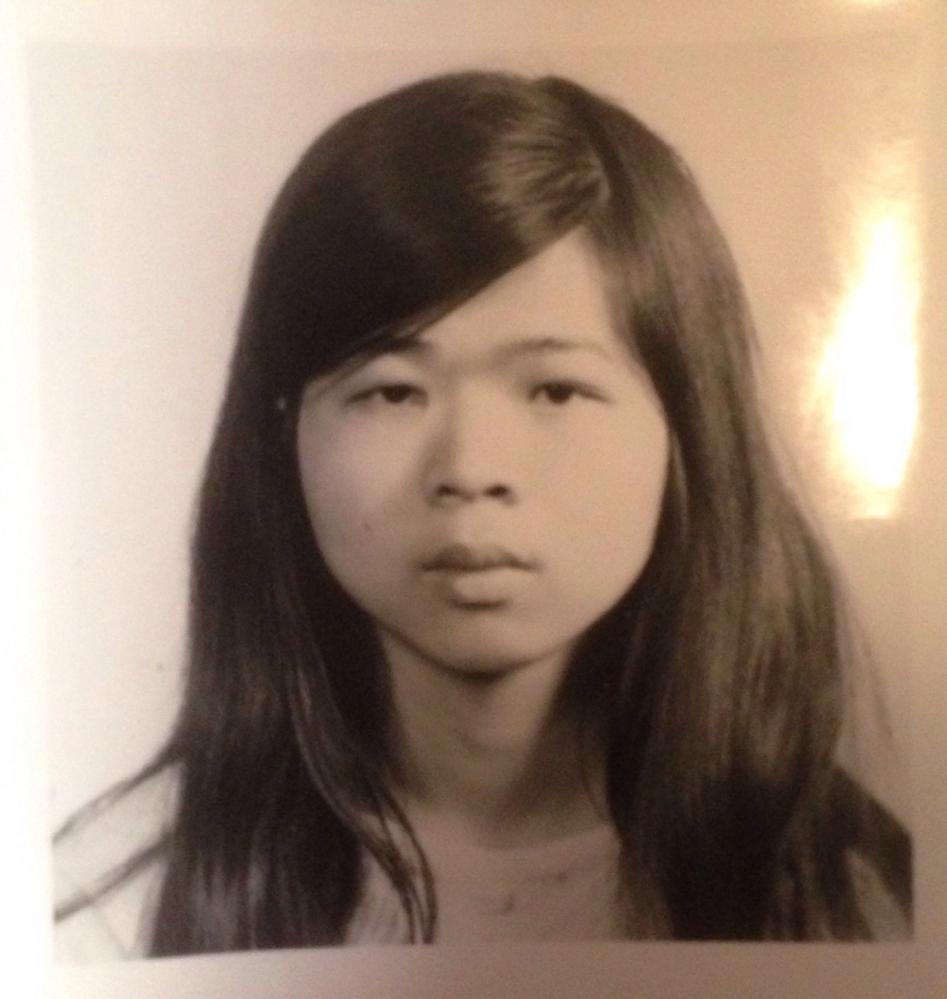
Susie’s passport photo in 1975, when she was 25


In September 2012, my start-up 1000memories was acquired by Ancestry.com, setting off a chain of events that would lead me to Taiwan to look for Susie. Suddenly, family history was my full-time job, and I felt inspired to learn more about my birth mother. I petitioned the Family Court of Clark County, Nevada, to open my adoption records. The Court granted my request, revealing Susie’s last name.


Susie’s last name led me to her younger brother and sister in Las Vegas, whom I found by cold calling numbers in an online telephone directory. A DNA test verified our relationship. Susie’s siblings had lost touch with her in the 1980s, and they guessed that she had moved back to Taiwan. Her brother gave me a passport photo of her when she was 25 years old, as well as an immigration document with her name written in Chinese, her birth date, and Taiwanese identification number.


When I left Las Vegas, boarding the first of three flights for Taiwan, I had many questions. Was Susie still alive, and if so, was she in Taiwan? What did she do? Did she have a family? Why had she lost touch with her siblings? How would she and I feel if we met? What would happen afterward? I imagined many different stories and scenarios -  but not what was about to happen.


I arrived in Taipei at night on Wednesday, October 23. Within 24 hours, I hit a dead end. An official at the local government office in Taipei told me that Susie had left for the United States on March 25, 1981, two weeks before I was born. The Taiwanese government had no record of her ever returning.


I spent the next few days exploring Taipei, taking long runs to help recover from jet lag, and contemplating my next move. I called Susie’s siblings, but they didn’t know more than what they had already told me. I reached out to a few private investigators in Taiwan. They suggested I go on Taiwanese TV to tell my story (apparently, many Taiwanese-Americans have been reunited with lost family members this way). Disappointed, I wondered if it would be more fruitful for me to shift my search from Susie to my birth father Thomas Llewellyn Hughes—who, I suspect, remains in Asia if he’s still alive at 83.


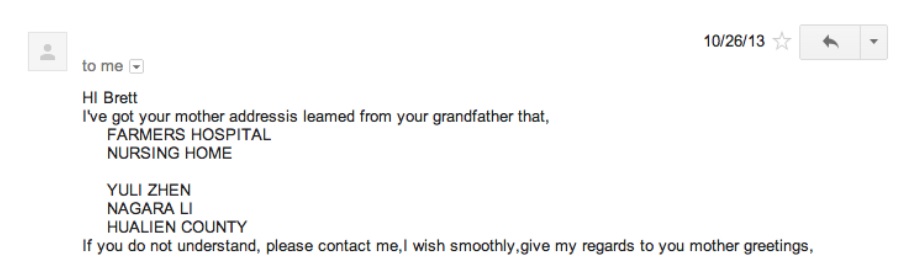
Then, on Sunday, I had a breakthrough. Susie’s oldest brother David called me. David also lives in Las Vegas, but we had not met because of an ongoing dispute between siblings. Despite barriers in communication (I do not speak Mandarin, and David has an accent and unique diction in English), I explained that I was in Taiwan looking for Susie. Within a couple hours, he emailed me an address in Hualien, a rural county on Taiwan’s remote eastern coast.


bh_email


I asked for help from the Westin Taipei’s concierge, a young woman named Alice. Without offerings details, I gave Alice the address, and told her I was looking for a woman named Susie born on May 3, 1950. Alice googled the address, called the number she found, and spoke for a few minutes in Mandarin with the person who answered. After hanging up, she turned to me and said:


They say there is a woman there named Susie. She is approximately the same age as the woman you are looking for, but they cannot confirm her birth date because they do not know what her birth date is. Are you sure this is the right place? I do not think this is the place you are looking for. It is called Farmers Hospital. It is for the homeless.


The next morning, Alice and I met at Taipei Main Station at 7 a.m. Alice, who had graduated from the University of San Francisco a few years earlier, offered to accompany me as a translator on her day off. On the four-hour train ride, Alice and I talked about life in San Francisco, and she taught me how to count from 1 to 10 in Mandarin.


Mostly, I wondered if the Susie I would meet that day would be my birth mother — and, if so, what it would be like to meet her. We traveled down the mountainous eastern coast of Taiwan, between the sea and the green mountains, past the municipal capital Hualian, past the Taroko Gorge where most passengers got off, past the rivers and rice fields of southern Hualien County, until eventually we arrived in the sleepy farming village of Yuli. I felt a little bit like Marlow in an idyllic version of Heart of Darkness: nervous and excited in a foreign land.


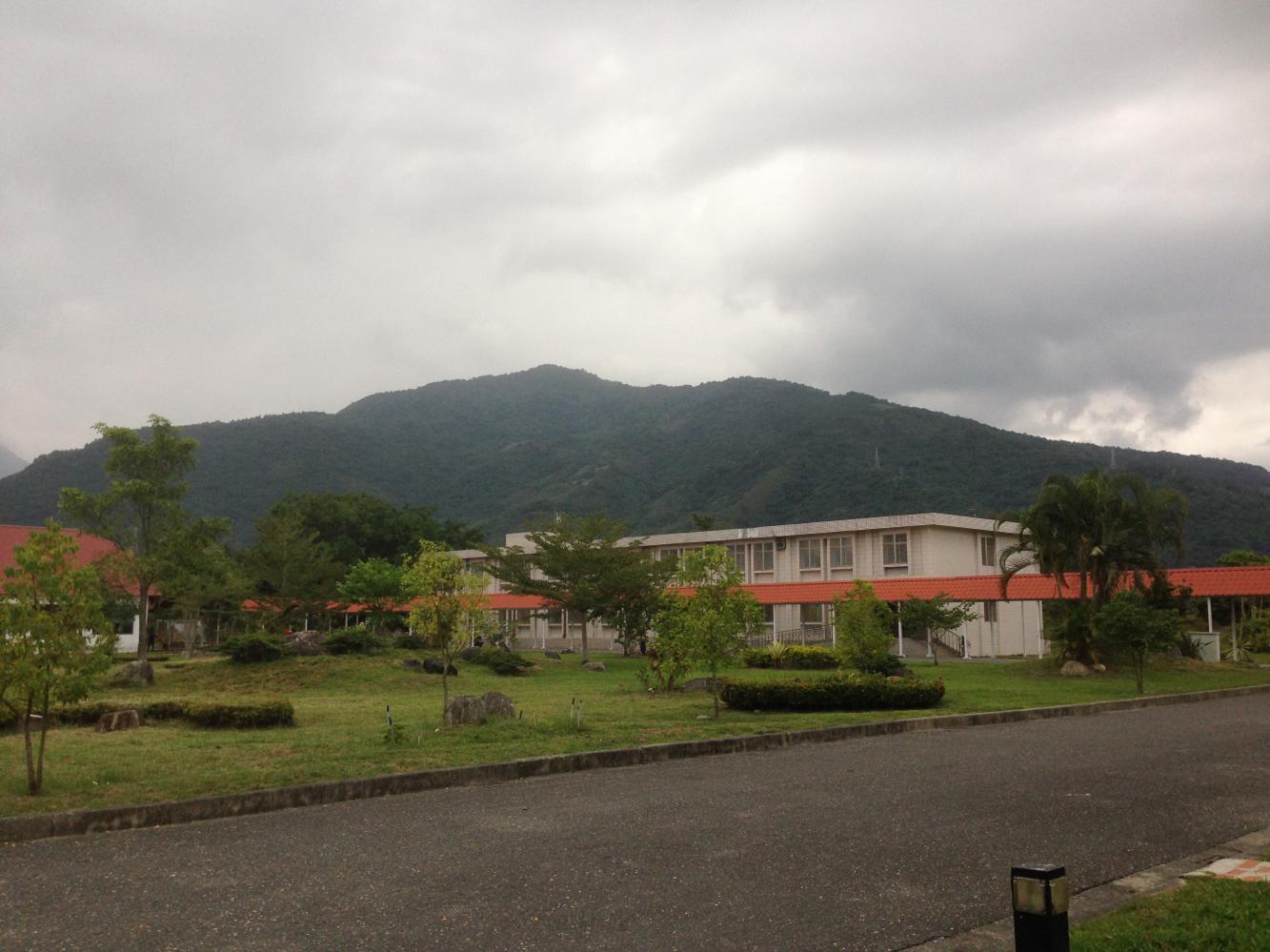
We took a 15-minute taxi from the train station to the hospital outside of town. I left my suitcase with the security guard out front.


bh_yuli


The women’s building at Farmers Hospital in Yuli


When we entered the women’s building of the hospital, Susie was standing in the middle of the TV room. There were perhaps 10 other women, whom the nurse quickly ushered out. All of them, including Susie, were wearing orange sweat suits. I noticed that Susie was short and chubby, and her black and white hair, cut short like a man’s, stuck up wildly in the back -  like mine does when I have bedhead.


“Hi,” I said. She smiled but didn’t say anything. The nurse explained through Alice that Susie is nearly deaf, and she can only hear if you shout Mandarin into her left ear.


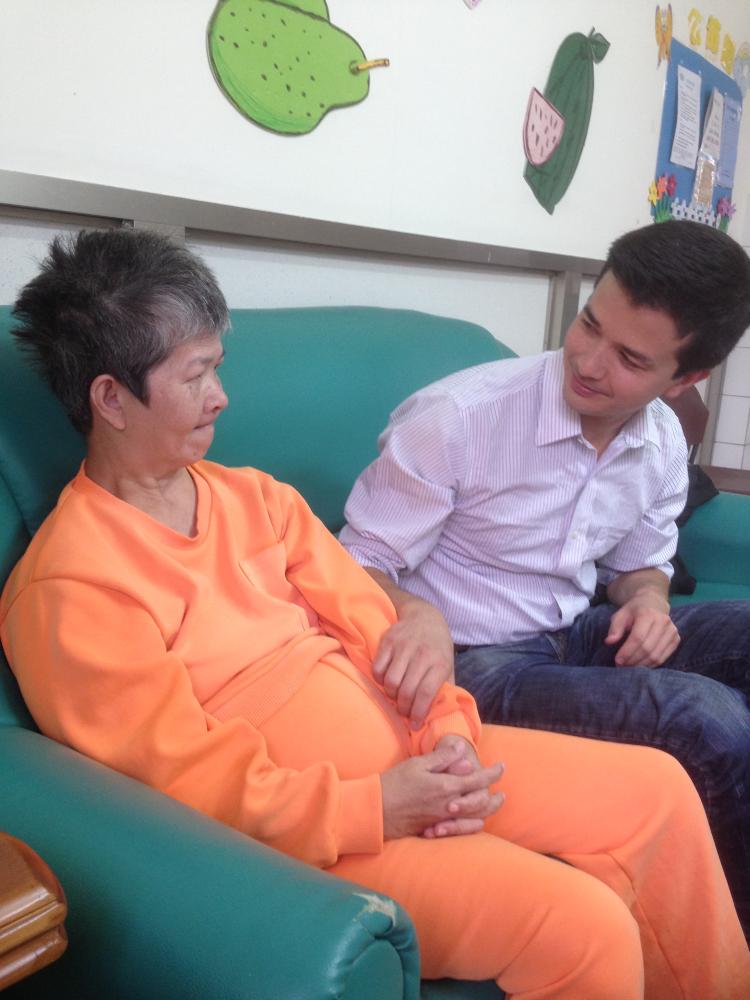
We sat down on the green plastic couch, and we tried to have a conversation. Shouting into a 63-year-old stranger’s left ear felt awkward, so Alice and I “spoke” to Susie by writing Chinese characters on white sheets of paper. Susie read them and then responded with short, simple answers.


bh_sofa

Susie and I on the green plastic couch


I asked Susie how she was doing, and how long she had lived in the hospital. I asked her questions about her family, her children, and her past. Her memory was hazy, and she could only remember the vaguest of details. She didn’t know how long she had been there. Her father worked in the Air Force. She went to high school in Tainan. She had lived in Denver and Las Vegas a long time ago. She had two sons and also a daughter. She could not remember her daughter’s name.


Convinced by our physical resemblance and similarities in our stories, the nurse began to tell Susie that I was her son. Susie shook her head and waved her hand in disbelief. The nurse kept repeating in Susie’s left ear and pointing at me, “This is your son!” Susie could not and did not believe it.


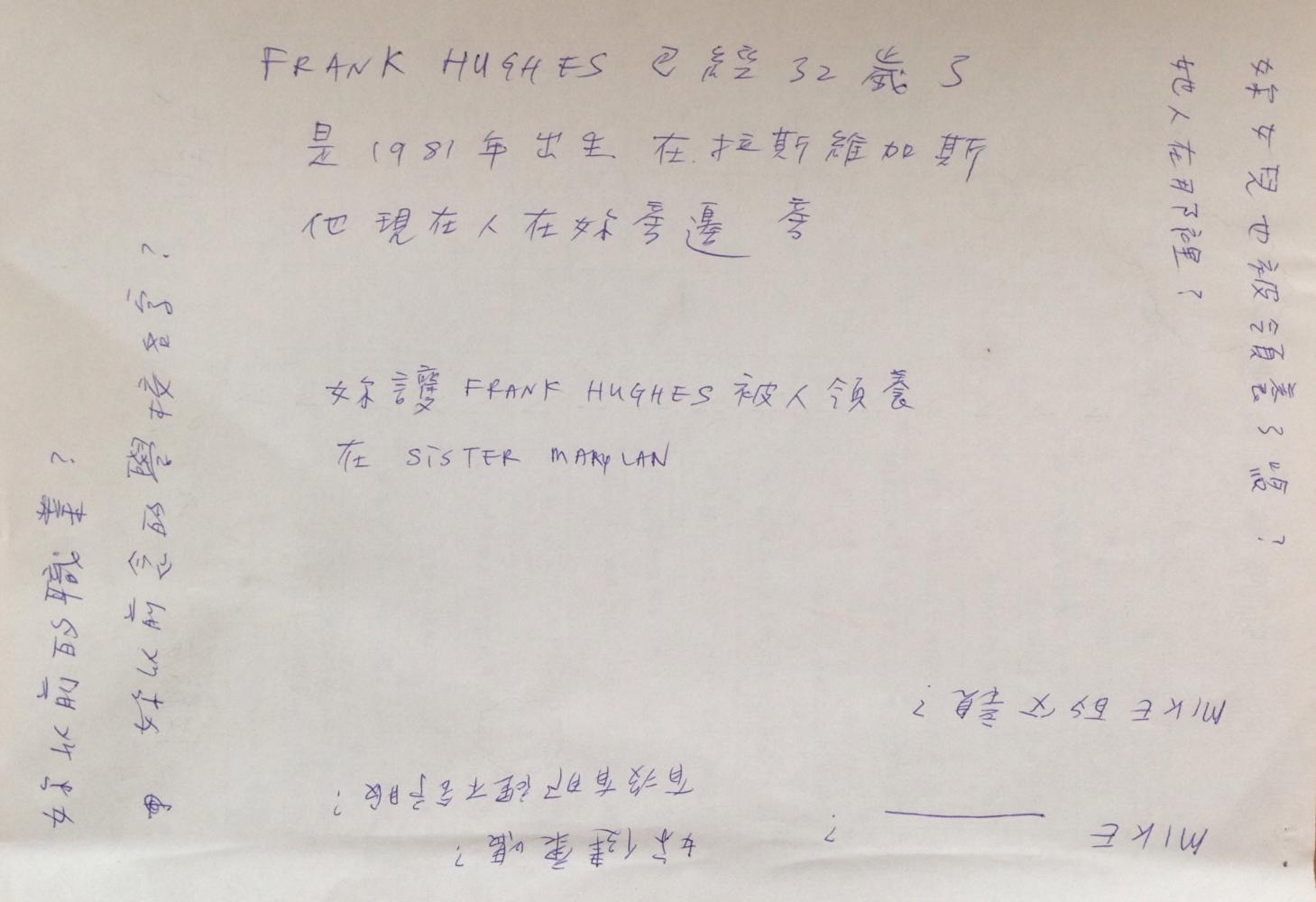
I wrote down on a sheet of paper in big capital letters, “FRANK HUGHES.” A few months earlier, I had learned from my original birth certificate that Frank Hughes was my original name. I showed the paper to Susie and pointed at the words.


bh_alice


One of the sheets of paper that Alice and I wrote on


“My son,” said Susie matter of factly. “Sì Jiǔ.”


Alice reminded me that Si Jiǔ means “four nine” in Mandarin. I realized that Susie called me Si Jiǔ to remember my birth date  - April 9.


“I am Frank Hughes. I am Sì Jiǔ. I was born on April 9, 1981, in Las Vegas.”


Susie grinned widely, almost as if I had embarrassed her. She shook her head and waved her hand, and then she turned to the nurse and said: “My son would not visit from the United States. Plus, he is too handsome to be my son.”


The next day, I returned to the hospital to visit Susie and meet her social worker Sui-Ching. Mei, the warm-hearted, 60-year-old proprietor of my B&B, replaced Alice as my translator.


The social worker showed us Susie’s medical records. “Schizophrenia” jumped out in English — no translation required.


According to Sui-Ching, Susie was in good physical health but suffered from mental illness. Her symptoms had improved over the years, and her hallucinations had become less severe and less frequent. Unlike some of her roommates, she could feed herself and dress herself.


“How long has she been here?” I asked.


Sui-Ching explained that Susie was picked up off the street and admitted to a sister hospital in Taipei as an “unknown person” more than 16 years ago, sometime during the 1980s or 1990s. In 1997, the hospital in Taipei burned down, and Susie was transferred to Yuli. Unfortunately, nothing else about her was known because all medical records were destroyed in the fire, and her attending physician had passed away.


I spent the rest of the week in Yuli, visiting Susie once a day. I tried to think of activities that would make our communication deficiencies less apparent. Susie made it easy. She smiled a lot, and she seemed genuinely pleased that a friendly stranger had come to visit from the United States.


bh_facetime

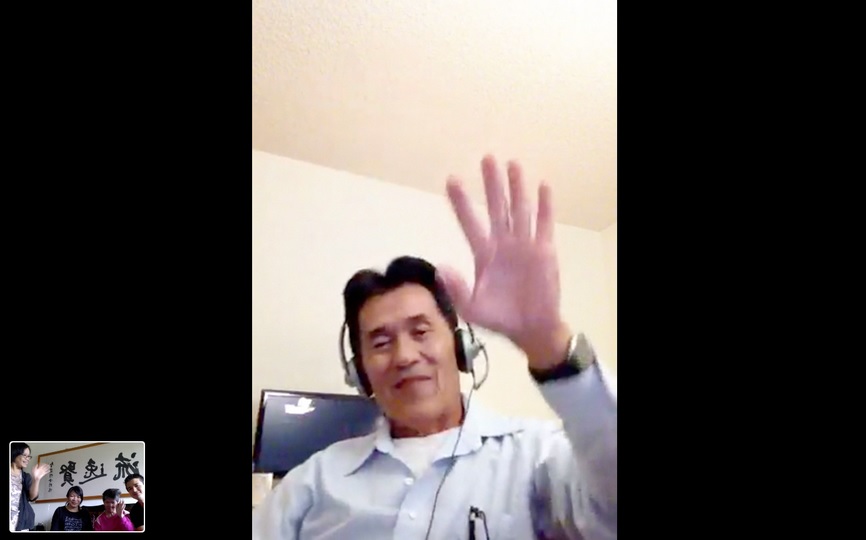
FaceTime with Mei, Sui-Ching, Susie, David, and me


We took walks around the peaceful grounds of the hospital. One day, her social worker and I took Susie to get her hearing checked at a clinic in Yuli. I wanted to buy her hearing aids, but Susie refused because they made the world too noisy. Another day, we used the internet connection at my B&B to make a FaceTime call to her older brother David. They hadn’t seen each other for 35 years. Susie didn’t recognize him at first, but after about 15 minutes, she understood who he was. She could not hear him, so she decided to write on a sheet of paper in Chinese, “I am happy,” and she showed it to him.


bh_polaroid

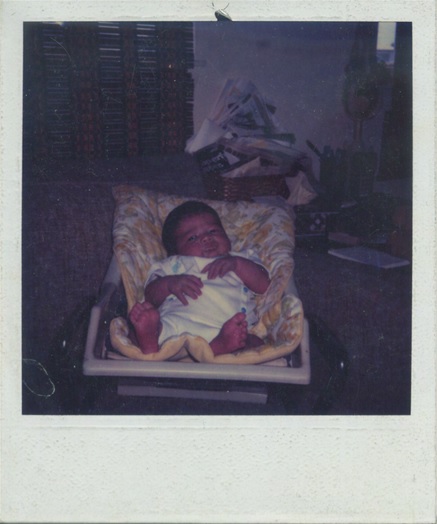
My first Polaroid


Each day, I showed her pictures on my MacBook Air of my evolution from baby, to boy, to adolescent, to adult, to the present day. I started with the first picture of me ever, a blurry Polaroid that Susie had taken herself when I was only a couple weeks old. I thought that through pictures, she might realize that I was her son. She never did.


At the end of the week, many questions remained unanswered. What triggered Susie’s schizophrenia and when? Did mental illness influence her decision to put me up for adoption? Why does the government have no record of her return to Taiwan? What happened to her in Taipei, and how did she end up on the street? Who and where are my half-brother and half-sister? Will I ever meet them or Thomas?


I wasn’t going to leave Yuli with these answers, but I did want to leave something behind for Susie. I wrote a short note, and Mei help me translate:


Your son Frank Hughes is very grateful to you for giving birth to him and for putting him up for adoption. He is now 32 years old and has had a very good life — loving family, great education, fulfilling career. He is happy and proud to be your son.


I also made copies of two photographs — the Polaroid of me as a baby, and a picture of us together from the visit. Sui-Ching laminated the letter and the photographs together so that Susie could keep them safe.


Maybe one day Susie will see the note and photos and realize who I am.


The author thanks Lauren Ladoceour, Beth Huneycutt, Ashley Huneycutt, Felicia Curcuru, and Rudy Adler for reading drafts of this memoir.


*


This article was originally published on Medium .