Showing posts with label Life. Show all posts

Wednesday, April 16, 2014

The “Model Minority” Report: Building ‘Em Up Just to Tear ‘Em Down

In the U.S, being “Asian” carries implications beyond ethnicity and country of origin. Particularly in the classroom setting and the workplace, being “Asian” implies ambition and excellence, high-achievement and success. In America, being of Asian descent puts you in the category of the model minority, the minority group has made it – the group that assimilates itself most successfully in that country, and essentially, winners of the American Dream.


asian-americans-more-educated-successful

A perfect photo op: President Obama signs Executive Order 13515, “Increasing Participation of Asian Americans and Pacific Islanders in Federal Programs”


When I first learned about Asians being the model minority, I didn’t think there was anything particularly wrong. On the contrary, I figured, if every minority is associated with a stereotype anyway, then the “model minority” is probably a good standard to uphold to. After all, who doesn’t want to be part of the group that has the highest education rates and lowest crime rates?


Conventional success, no matter how inside-the-box, beats unconventional failure. Everything has multiple facets, and if this is the good side of racism, so be it.


asian-dad-meme-education

Memes like these “Asian dad” ones are easy – to come up with, and to hit the target


It’s hard to vocalize stereotypes, especially when they seem to work in your favor. I can’t deny that part of the reason I work so hard is because I know that the standards I have to meet are high. Does the model minority stereotype push me to excel? I am generally an outgoing person, but if I don’t want to participate in a classroom setting, I will take advantage of my “quiet Asian girl” appearance and sit invisibly in the classroom, undisturbed by professor and classmates. We find it hard to justify our perturbation with the model minority stereotype when, in fact, we believe that we are beneficiaries of it.


asian-american-model-minority-myths-broken

CAPAC dispels some Asian American “model minority” myths, but no matter how catchy the infographic, it’s up against much more


Yet, the thing is, we’re not.


The model minority status is an excuse.


It is an excuse bestowed upon Asian Americans telling them, “Look, you’re smart and successful not because you worked for it, but because you are Asian, and this is how your people are.” The model minority stereotype appears to be an agent to our success when, instead, it strips us of our own self worth.


Why should I believe that my hard work is motivated by racism, when it is in fact, a part of who I am, and a reflection of my tenacity and strength? Why should I be able to play up the “quiet Asian girl” appearance, when that is not who I am, when such a type shouldn’t even exist? As a people, if we are a people, we should identify with our culture of origin – if we want – but that’s different from the model minority stereotype, because that is a categorization that was placed out of our control.


Tuesday, April 1, 2014

Actor Wen Zhang Cheats on Wife; Apologizes to World in Recordbreaking “Tweet”

What’s trending on Weibo, China’s Twitter?


Is it the latest crackdown of President Xi’s anti-corruption campaign, which seized 90 billion yuan (US $14.5 billion) from the family and associates of former security chief Zhou Yongkong? The flexing of President Putin’s muscles over Ukraine and Crimea instead of a hapless trout or wayward horse? The two-week long protest over a trade pact across the Strait in Taiwan? The still-missing Malaysia Airlines plane?


weibo-apology-wen-zhang

When a Hallmark card won’t do, there’s Weibo…


Sex wins out over money and politics: Weibo blew up with actor Wen Zhang’s long apology over his affair with Yao Di, his costar in 2011′s popular drama 裸婚时代 (Naked Marriage). Wen is married to actress Ma Yili, his co-star from a 2007 drama (奋斗/Struggle); the couple have one daughter, and Ma is currently expecting their second child.


wen-zhang-ma-yili

Wen Zhang with wife Ma Yili on the red carpet


wen-zhang-yao-di-naked-wedding

Wen Zhang with alleged extramarital affair Yao Di in better times, on set on drama 裸婚时代 (Naked Marriage)


wen-zhang-yao-di-caught-affair

Wen and Yao on a “secret date” in Hong Kong, despite… some… attempts at disguises


Wen’s apology reads, in part, “I have brought this upon myself. A mistake is a mistake… This has nothing to do with anyone else. Today, I am willing to accept all the consequences. I’ve let down Ma Yili and our children. My mistake does not deserve to be forgiven, and it will be difficult for me to make amends for all the harm I’ve caused. But I want to do it. I have to do it. This is what I’ll do for the rest of my life.”


In response, Ma wrote, “Being in love is easy; being married is not. It is to be cherished.”


A “naked marriage” concerns a modern practice in China: couples who wed and eschew the traditions that precede and follow that status: no ring, no ceremony, no honeymoon, no house, no car. (The latter two involve the usual exchange of gifts between the families and for the benefit of the newly married couple.)


The couple that Wen and Yao play in the drama, by the way, do not last.


From last week’s public “conscious uncoupling” announcement of Gwyneth Paltrow and Chris Martin’s separation to Wen’s most-retweeted apology, what new trend are we seeing?


Monday, March 10, 2014

Migrating East: The Growing Expatriate Population in China

Because our breadwinner is an international businessman, my family has moved countries many times. Most people think our migratory patters are odd; when looked alongside global trends, though, they make sense.


Ten years after the fall of the Iron Curtain, when Eastern Europe began to welcome Western investment, my family and I moved to the Czech Republic. When the business world started buzzing about the growth of the Brazilian economic power, we’d already been living there for a year. When we arrived in China, though, we were late to the party.


The international community in Shanghai was nothing like what we’d encountered before. We saw Westerners, or waiguoren, almost everywhere we looked. (It was definitely still China, and things like squatty potties reminded us of it.) When we arrived in 2010, we were only five new members in an ex-pat community of more than 1,000; by 2013, the number had reached 173,000 people.


Foreigners living in China, at least according to HSBC, tend to love it. In its 2013 survey of over 7,000 global expatriates, China was found to be the best overall destination. Highlights included that those living in China were the only ones to report to enjoy a more active social life than in their previous country. Almost 75% of respondents with children considered China safer for them than other countries.


However, while these interviewed were glad about the additional benefits to their quality of life, it wasn’t usually a better social life or children’s safety that foreigners sought when they moved to the Middle Kingdom. Many companies send employees to the “Wild East” to open ground on new markets and opportunities. In Shanghai, an arena that seemed to be incredibly important was the car industry: it wasn’t a coincidence if the first three Americans you met who worked in Shanghai were all from Michigan.


In the last twenty-some years, the city has developed at a jaw-dropping speed.


nowandthen_shanghai

Twenty years in Shanghai


From the omnipresent Starbucks to the newly opened Old Navy to Western-style restaurants like Element Fresh, it’s clear that the West is dominating this trend. There’s even a movie based on it: Shanghai Calling (2012), with its “strangers-in-a-strange-land” premise about an ambitious American attorney assigned to Shanghai. It may not be as funny to some, but I’d recommend watching it to learn a bit about Shanghai, China, and Western investment.


Either that, or hop on a plane and see it for yourself.


Wednesday, March 5, 2014

Who’s Got the Best School Uniforms in Asia?

What’s in a school uniform? (And, if you clicked on this story because the main image showed EXO-K[orea]‘s six members – all well out of high school – still dressed in school uniforms for a photo shoot, you kinda understand the appeal of the school uniform in popular Asian, and non-Asian, imaginations.)


Japan


Visiting, you’ll see groups of students wearing school uniforms. Some may have graduated, actually; there was once an on-street interview asking those who’d left school why they still wore their uniforms, with the popular answer, “Because the uniform is still our favorite piece of clothing.” It’s a bit of a fashion symbol.


The reality:


japanese-uniform-boys-super-cool

Some super cool boys who go to the same hairstylist


japanese-uniform-girls

Some super cool girls – the “sailor” look is typical of Japanese school uniforms


The not-so-reality:


japanese-uniforms-street-style

Mutton dressed up as lambs – I mean, “street style”


South Korea


The Korean uniform is another one that’s steeped in pop culture: the girls usually wear white shirts and plaid, pleated skirts, while boys wear white shirts and trousers. Indeed, the uniforms show energy and some fashion.


The reality:


south-korean-uniforms

Some Korean students


The not-so-reality:


SNSD-school-uniforms

SNSD/Girls’ Generation in a world of their own


to-the-beautiful-you

The cast of To the Beautiful You, a K-drama set in high school


Thailand


Schools in Thailand have strict dress codes: all students from primary schools to universities are required to wear uniforms every day. While primary schools’ uniforms are usually in bright colors, older students follow the white top (blouse, shirt) and black bottom (skirt, trousers) look. In 2013, Thai university uniforms were voted the “sexiest” among Asian uniforms by a poll conducted by Japanese media.


The reality:


thai-school-uniforms

A middle school in Thailand


The not-so-reality?:


thai-coed-uniforms

A form of university-regulated uniforms


Malaysia


Malaysia is a Muslim country, so the students have very strict dress code. The girls’ skirts must be below the knee, and the sleeves long enough to cover elbows.


The reality:


malaysia-school-uniform

Modesty in pinafores


Vietnam


The ao dai is a traditional Vietnamese costume with hundreds’ of years of history. A search online has many visitors talking about this beautiful scene: girls in white ao dai, riding a bicycle or walking and talking to friends. Clean, fresh, and all-purpose. Besides, selecting traditional wear as school uniforms is a brilliant idea: it provides a way for the younger generation to learn and be proud of their ethnic identity and culture.


The reality:


vietnam-school-uniform-ao-dai-bike

Two students ride a bike to school


The not-so-reality?:


vietnam-school-uniforms-ao-dai

Couldn’t tell if this was a photo shoot; the ao dai are missing the school’s emblem over the chest


China


School uniforms in China are basically sportswear, designed for activities, with a clear lack of fashion. Most Chinese uniforms that aren’t exercise outfits follow the Japanese/Korea styles, with blazer, shirt, and skirt/trousers.


The reality:


china-school-uniform2

Exercise those young minds!


chinese-school-uniforms-special

A step above the “sporty” look


Saturday, March 1, 2014

My Yéye: More Than My Grandfather

My yéye (爺爺; paternal grandfather) was born in rural China and grew up in the relatively tranquil countryside with his mother, grandparents, and two older sisters. Mischievous and energetic, he spent his time – when not in school – playing with the family cow.


china_countryside_flickr

Chinese countryside


Outside his village, though, raged the political upheaval following the end of the Qing Dynasty. When he was ten years old, he and his family were forced to flee from the Chinese Civil War. He would not see his father and his sisters for the next forty years.


Until this point during this autobiographical interview with me, he’d been happy and enthusiastic to reminisce. Here, he could only shake his head and repeat in Mandarin, “It was horrible, absolutely horrible.” He spoke haltingly, his expression stony as he recounted the horrors he saw as he and his mother escaped to Taiwan: the never-ending trail of bodies, piled up to obstruct the refugees; the nauseating scent that filled every breath he took; the thick, black clouds of flies that blocked the sun in the sky.


In Taiwan, my grandfather worked in a cloth factory to support his family, earning about $5 a month. At the age of 20, he joined the Navy and worked as a dispatcher, waving flags to relay messages to passing ships. Despite only finishing grade school, he continued to study and climbed to the top as the captain of a commercial ship.


He fell in love with sailing and traveled the world with his crew, a wonderfully simple and uncomplicated life unknown to civilians on land. Every two years, he’d return to Taiwan to spend time with his wife and children. When I was almost one year old, he and my grandmother immigrated to California to be with their son – my father.


It was a poignant hour for me as I asked him questions. I realized that while deep furrows carved creases in his face and liver spots dotted his wrinkled hands, my grandfather’s mind was still as young and nimble as the sharp sailor he must’ve been.


ROCN-navigating-battle-ship-pennant

ROC Navy navigating battle ship pennant from the 1950s


When he spoke of his youth and his beloved grandmother, his face simply lit up. His memories were not filled with reluctance or agony but instead with vigor. Laughing through his ship dispatcher tales, he nonetheless complained humorously about the nonstop whizzing of bullets and how his calves throbbed when he felt scared in battle. He basked in the glory days of being captain of his own ship; chortled and exclaimed, “Of course, of course!” every time I asked him if he had visited a particular country.


Radiating with pride, he emphasized how, although he’d only received less than six years of formal education, with sheer dedication and resolve, he attained one of the highest scores on the sailing examination. (And, despite knowing no English when he arrived in the States 17 years ago, he’s acquired a strong grasp of the language.) With great certainty, he told me to keep willpower and integrity, the two traits that he learned were essential for creating a strong individual. After all, “failure is only a step towards success.”


Before this interview, conducted nearly four years ago, I’d never really seen my grandfather as anyone else but my dad’s father, whom my father admired above all others and who lovingly takes care of my Alzheimer’s-affected grandmother. He’s always called me a “good child” and constantly tries to give me pocket money when I visit.


In talking to him, I learned that he was also a beloved son, grandson, and brother; a refugee, a factory hand, a captain, an immigrant. He is also the most influential and inspiring figures in my life.


Monday, February 24, 2014

Category, People: He Hacked “Jeopardy”

Who is Arthur Chu?


A 30-year-old compliance analyst and voice-over performer from Cleveland, Ohio, Chu’s four-day winning streak on Jeopardy (total: $102,800) has brought trivia fans and game theorists into the same room – but, like a junior high school dance, at opposite sides.


He returns today for his 5th appearance.


Chu’s tactics on the show includes a hovering thumb over the buzzer (pressing before Alex Trebek completed the sentence) and the “Forrest bounce”, first executed by Chuck Forrest on Jeopardy in 1985, which forgoes the established method of following through with one category from top-to-bottom and instead hunts around the board to find and clear Daily Doubles. (Chu wagered the minimum of $5 in categories he did not know.)


jeopardy-board-trebek

The Jeopardy “game board”


The carpal-tunnel buzzer-blitz is to prevent the Who Wants to Be a Millionaire chit-chat drag: to get through as many questions, and as much monetary winnings, as possible. The “Forrest bounce”, as noted in a Slate article by Ken Jennings (the Jeopardy champion only defeated on his 75th appearance), has been used a few times between Chuck Forrest and Arthur Chu: by David Madden (2005), Roger Craig (2010-2011), and IBM supercomputer Watson (2011).


And, even more so than how Chu is smashing what the viewers expect of the game itself in his “unsportsmanlike” behavior, he’s also targeted for his rumpled, nerdy looks. The Jeopardy “villain” is easily targeted for the lowest common denominator of racial epithets: his haircut, his “chinky” eyes, his size, his clothes, his masculinity. What, nothing about his celebratory dinner of dog meat?


twitter_arthurchu

(Compiled by Angry Asian Man)


Chu has been giving as good as he’s gotten on Twitter.


arthur-chu-twitter-reply arthur-chu-twitter-reply2

He’s also refreshingly self-aware in interviews:


“The unspoken rule is that if you’re on Jeopardy, you should be in a suit and tie, you should be genteel, and here I am, I’m poorly dressed, I have a bad haircut, I’m intense,” he says. “Well, the fact is it’s ludicrous: I’m an out of shape, nerdy Asian guy who’s become a ‘sports legend’ because I’m good at a trivia game. What do I have to apologize for? This is the only time in my life I’m going to get to do something like this. Of course I’m going to milk it! If I don’t, it’s back to a life of office jobs and being a nerdy Asian guy.”


Here’s a question: Why go on game shows, if not to win?


Damn if you do, and damn if you don’t. But I know which one I’d rather choose.


Wednesday, February 12, 2014

Pen Spinning World Cup 2014: Yes, It’s Real, and You Won’t Believe These Tricks

The Sochi 2014 Olympics proceeds, to the attention of the world; but, in a small and unabashed corner of the internet, another global competition rages – the Pen Spinning World Cup 2014. With teams from 10 countries competing, the tournament is one of pen spinning community’s largest group events.


Yeah, this is a real thing.


Each of the five rounds of the tournament is comprised of three battles: two singles (1v1) and one double (2v2). The single matches are separated into two themes: artistic and technical. Videos of the pen spinning are uploaded, and judges evaluate them based on five criteria: execution, difficulty, creativity, presentation, and theme. The tournament will be completed at the end of May.


February 2014: Round 1, Group A, HAL from Team JEB wins against a battle in the “artistic” category


You’ve probably seen pen spinning in class, or have even done them yourself. Pen spinning, also known as “pen tricks”, is the art form of twirling and manipulating a pen, though its teenage practitioners almost exclusively spin custom “mods” with no writing utility, optimized for weight and balance.


Motivated by competition and artistic innovation, pen spinners carry their “sport” to skill levels ludicrous to the unpracticed eye. The pen passes, rolls, and spins across the hand and between the fingers. There exist “fingerless” tricks that exclusively use wrist and palm movements, and some pen spinners have even experimented doing tricks with their feet.


Do you think this would fall under the “summer” or “winter” Olympics?


While the precise origin and history of pen spinning is unknown, the first record of pen-spinning comes from a student in pre-World War II Japan. The activity became popular in the 1970s, and after the advent of the internet, blew up due to the ability for pen spinners to discuss their craft on forums and share videos. As a result, pen spinning clubs have formed in the Philippines, and live tournaments are conducted in Japan and South Korea. Businesses have attempted to capitalize on the custom-pen market.


Asia retains the largest communities of pen spinners; South Korea alone has over 300,000 spinners. On the forum UPSB (Ultimate Pen Spinning Board), one thread discusses the connection between Asian ethnicity and pen spinning. The obvious answer is that pen spinning originated in Asia; hence, most pen spinners and “pros” are Asian. But there may also be specific cultural reasons why pen spinning took place in Asia. Forum member Eso observed that when he spun in public, Asian youth expressed a particular curiosity. He argued that “most Westerners aren’t accepting toward activities that are seemingly useless,” assuming that Western culture privileges utility and pragmatism over aesthetics.


What do you mean by “double” in pen-spinning? Kay and ACT show how it’s done.


Tofu, a forum member from Hong Kong, attributes the strength of Asian pen spinners to their dexterity developed through playing instruments, a sentiment that has also been expressed in the context of Asians and urban dance. However, in the end, most all agree that the skill of Asians in the pen-spinning world has less to do with cultural heritages, and more to do with the fact that most pen spinners are Asian.


But who knows: with teams from Germany, Poland, and the United States competing for the Pen Spinning World Cup, perhaps it’s only a matter of months before non-Asians take home e-fame gold.


Tuesday, February 11, 2014

Style Directives: What Are You Wearing?

When my mom and her friends visited China, they filled every possible space of their suitcases with Nike tennis shoes, Ralph Lauren polo shirts, and Coach bags. These American brand-name goods were doled out to their younger relatives and cousins, who valued the clothes not for fashion or quality but for the big logos splashed across the fabric. Even though this generation of Chinese teens are slowly discovering their own style, they won’t refuse this sartorial link to the West.


Yet, there remain differences in the way that Chinese and American teenagers dress, although their style directive often comes from the same type of sources: television, film, magazines. In the end, though, it’s culture that leads to different ideas about what and what not to wear.


I noticed how teenage girls present themselves. In the U.S., girls try out makeup, pull their shirts down and hike their skirts up – the goal is to look older. In China, where innocence and childish cuteness is widely prized, girls wear clothing with bows, ruffles, or characters like Hello Kitty in order to appear younger. Even though the Chinese like to borrow from Western fashion, they systematically reject the perceived openness of Western sexual attitudes. Do the girls want the Ralph Lauren sweater with a large polo player embroidered across the chest? Oh, yes. Do they want the mini-sundress with the low-cut back? Absolutely not.


japanese-kawaii-style

A few examples of the extreme – Japanese “kawaii” (cute) style


Another observation I had was the extent of celebrity worship and idol culture in China compared to the U.S. From my experience in the States, when celebrities, athletes, actors, or musicians release a clothing line or a new fragrance, a very small fraction of the most passionately devoted fans would anticipate and purchase the new items. (Except for H&M and Target designer collaborations – that’s a different story altogether!) For the vast majority, the difference between a pair of jeans designed by Justin Timberlake (from his co-founded William Rast line) and a pair of Levis is probably insignificant.


justin-timberlake-jeans

Britney and Timberlake – because these pictures are still hilarious


My Chinese cousins see it differently. When my family was planning to make a trip back, one of my college-aged cousins specifically requested that we bring back Michael Jordan t-shirts, with the logo or his name stated explicitly on the shirt, and with the silhouette of the basketball player leaping into the air, ready to dunk. As well, the sneakers had to be Air Jordans: not Puma, Reebok, or Adidas, but Nike Air Jordans. My cousin and his friends were fascinated by Jordan’s celebrity status, and wanted to wear his special line to express their idolatry to everyone.


Last, but probably the biggest difference, is the attitude towards counterfeit products. For most Americans, the thought of buying a fake Louis Vuitton handbag is upsetting. Although there are many websites and private sellers offering “silk” scarves, inspired-by-Hermès leather purses, or out-and-out duplicates of the latest goods still on store shelves, people tend not to buy them. However, it’s common to encounter Chinese street vendors offering “genuine” name-brand bags for just a fraction of the cost – perhaps a few hundred yuan instead of hundred of thousands – and just as common to see Chinese youths engaged in transactions.


For the younger generation, it’s not quality they seek, but the images of the luxurious lifestyle evoked by the brands. For them, fashion is a way to express what they want to be to their peers and colleagues, instead of an indication of who they actually are.


louis-vuittion-core-values-coppolas

“Oh, you know, just hanging with my director dad in an Argentinean field at dusk…


Of course, many of these trends have shifted in recent years. Celebrities and political figures like Peng Liyun, China’s First Lady, have shown up to prominent events wearing Chinese designers; the rise of tuhao will change purchasing trends. While the change is slow, and perhaps uncertain, it’s one that may bring Chinese designers to the world stage, and may mean emptier suitcases when we travel to China.


Friday, February 7, 2014

Buddha, the “Way”, and Christ: The Clash of Religions or Muddling of Beliefs?

In China’s long history, religious views have been a traditional mix of Buddhism (the religion imported from India), Taoism (a school of religious and philosophical ideas started by the sage Lao Zi), and Confucianism (the ethical and sociopolitical teaching originating from the prestigious scholar Confucius).


As early as the Han Dynasty (206 BC–220 AD), the emperor Wu managed to combine the three ideas into one ruling doctrine: the Unification of Three Religions (三教合一). People were trained in this ruling doctrine both in academic teachings and through their daily life; inevitably, this belief system led to conflicts due to the three different sources it absorbed.


In the 2,000 years after the Han Dynasty, Chinese people, shaped by their hybrid beliefs and frequently encountering new dogmas like Communism and Maoism, prove to be quite capable of embracing and adapting to a highly inclusive and multicultural – yet more or less contradictory – ideology.


Buddhism had a significant amount of influence the lives of the Chinese: a famous Chinese poem “Spring of the South” (江南春绝句) by Du Mu (杜牧) has the lines, The four hundred and eighty temples of the South Dynasty, / How many terraces are in misty cold rains? (南朝四百八十寺,

多少楼台烟雨中). Confucianism, as well, has an indisputable impact in Chinese moral standards: modern codes governing the behaviors of a country, society, and person were developed from Confucian classics. Both Buddhism and Taoism are compatible with Confucianism, a benign worldview with a focus on harmony and uniformity.


From the late 19th- to the early 20th-century, Protestant missionaries entered China through rampant Western colonial activities in the country’s northern coast. They built churches and set up relief charities and schools for children to disperse the gospel of Christianity. Many Chinese village women were converted and trained by missionaries so they could help to preach the new religion in their own dialects. These Chinese women, called “Bible women” by country people, walked on their tiny bound feet into villages and spread the ideas to other peasants. Thus, in such backward conditions, Protestantism grew vigorously among Chinese villages, especially on the southeast coast of China. The multi-rooted Chinese beliefs system became even more complex.


Protestantism seems a little “foreign”, but it’s not unpopular because it represents, to many, the “advanced” Western civilization. Blame it on cultural imperialism: in my childhood, I perceived Christian spiritual leaders only as fair-skinned, golden-haired, and elegant images that I gleaned from watching and reading Western media. In comparison, with Buddhism, one often sees the scenarios of elderly women, some of them illiterate, kneeling before a golden Buddha statue and murmuring prayers with incense.


So how do other Chinese actually deal with these varied and often contradictory ideas?


From my observation, their behavior tends to be ambivalent. For example, unlike those who are born into Muslim families, whose family lineage and traditions tend to determine their religious beliefs for life, many Han people have had too many choices. (Or, sometimes, during the years of the Cultural Revolution, deadly choices.) While the ruling Communist Party is atheist, it allows the presence of Buddhism, Taoism, Islam, Protestantism, and Catholicism in the country.


My aunt was a Buddhist from her youth to her forties, probably because her mother has been a pious Buddhist for over fifty years; yet, both of them believe in fengshui (风水), the philosophical Taoist concept. While my grandmother conducts Buddhist rituals, she also believes in ghosts and deities. A few years ago, a friend of my aunt persuaded her to convert to Christianity. They went to a local church together, and my aunt started to read the Bible; she still holds a belief in Taoist fengshui and still keeps a jade ornament of the Buddha. In her case and others, it seems perfectly natural for modern Chinese to have all of these religions present in their lives.


In my opinion, Chinese individuals are culturally acceptable to foreign religions, though it might take a long time to convince them in a new belief. Over time, Protestant idea was localized and absorbed by domestic cultures into China. Whether it – or something else – becomes a more compatible part of the Chinese beliefs system, remains to be seen.


Monday, January 27, 2014

The Chinese New Year Dilemma

With the advent of the Chinese New Year – China’s most important cultural holiday – controversial issues like pollution, environmental responsibility and the role of traditions are once again brought to light.


It’s no secret that smog levels in Beijing have been continuously reaching unprecedented levels, engulfing the city in toxic chemicals for days at a time. On the measurement scale, air quality levels in the past year have frequently fluctuated between levels going beyond the upper limits of the index and “hazardous” levels. Just last Wednesday, pollution soared to 26 times the safe level recommended by the World Health Organization.


The issue of air pollution is one of the focuses of the Xi administration. The government has worked to address this issue during the past year, offering economic incentives for cutting emissions and instituting fines and penalties for exceeding caps. Additionally, Chinese officials ordered highway closures to both minimize carbon dioxide emissions and prevent traffic accidents, as visibility in Beijing dropped to a mere 500 meters.


smog-beijing-surveillance


Beijing in November 2013

(Photo: Reuters)


Aside from the obvious respiratory and health problems caused by air pollution, there are also numerous negative economic effects associated with the closure of major highways and factories, prohibition of the use of government and private vehicles, and the cancellation of certain outdoor activities, all of which disturb the regular rhythm of the city. Pollution also serves as a major deterrent for tourism.


With the Lunar New Year coming up on January 31st, Chinese officials are extra cautious about air pollution levels. Deriving from ancient mythologies, fireworks and firecrackers continue to be treasured by Chinese citizens as deeply traditional aspects of the holiday, with celebrants setting off the explosives at midnight on the first and fifth days of the lunar calendar to bring good fortune. Unfortunately, they also bring smoke, dust, sulphur-coal compounds and toxic chemicals, which consistently produce spikes in air pollution levels. Last year, PM 2.5 levels jumped by over 500% following the midnight celebrations.


All of this has led Chinese officials to consider banning fireworks on Chinese New Year in relevance to smog concerns, as part of the Beijing mayor’s “all-out effort” against air pollution. Xinhua News reported that the ban will be implemented if pollution reaches the severe “red” or “orange” levels. As such, overall firework cartons are reduced by 10%.


For the good of the environment, perhaps we’ll have to resort to videos of fireworks, as some watch videos of merrily crackling logs in a fireplace?

(New Year’s in Hong Kong)


However, people have been frequently dismissive of past bans, lighting up firecrackers in spite of official recommendations. The long-held custom is not easily or lightly abandoned, as demonstrated in an online poll by China Youth Daily, which reports that only 983 of their 2,529 respondents will refrain from lighting firecrackers – a mere 38%. While modern Chinese governments frequently choose “progress” over traditions, this is a sentiment that does not seem reflective of many Chinese citizens.


As a compromise between cultural preservation and environmental responsibility, Beijing will provide “environmentally friendly fireworks”, which contain no sulfur and produce less smoke. However, the higher price tag may deter people from opting for the greener option. As the holiday approaches, Chinese residents will be facing a choice between setting off the fireworks or not, though it seems many have already made up their mind.


Saturday, January 25, 2014

A Morning Swim in North Korea

I swim because I love the sense of freedom I feel in the water. This sensation of unboundedness, of unrestrained fluidity, is even more pronounced when at the water’s edge lies a fenced-in land of captivity. The Yalu River separates the hermit kingdom of North Korea from China, and it was in the Yalu that I swam, just upstream of the crane-sprouting Chinese city of Dandong, on a clear October morning.


Yalu-River-swimmers


Yalu River swimmers with North Korea on far shore

(Photo: Victor Robert Lee)


As I spat into my goggles a few steps from the water, to my surprise, nine men and one woman walked down the embankment in their swimsuits, put on fins and high-tech hand paddles, and started to slide into the river. A few smiled at this stranger in trunks, and one of them, short and muscular, with a clutter of teeth and circular fire-cupping imprints across his back, signaled for me to get in the water next to him. He later told me his name was Yi Hong Fung.


Most of the swimmers gradually dispersed in the direction of the far shore, about 500 meters away. But Yi and I swam together, alternating between freestyle and breaststroke, occasionally testing each other’s speed. I felt light and fast, and probably could have quickly outdistanced him despite his paddles and fins (much of my youth was spent in competitive swimming), but this was not a race. And I didn’t know if the swimmers were going to pass the river’s midpoint, the official boundary, or veer back toward the Chinese shore.


Answer: We stroked all the way to the far bank and landed a bit downstream because of the current. Yi stood in the North Korean mud and warmed up in the sunlight. I needed the sun, too. You can imagine the water was cold, yes, but it was bearable because of our exertion, and to my surprise, it seemed clean—no litter, suds, turds or taste of diesel. We stood next to a four-meter-high fence of ragged netting held up by poles that looked like scavenged tree branches—North Korea’s protection against invading swimmers and escaping citizens.


North-Korean-shore-old-boat-soldiers


North Korean shore of Yalu River at Dandong

(Photo: Victor Robert Lee)


The riverbank was a gradual rise of swamp grass; twenty meters from where we’d landed there was a small white shack—a North Korean guard station. There were no visible gun-toting Democratic People’s Republic of Korea soldiers here, as there had been the day before at the upstream trickle of a Yalu branch at Tiger Mountain. There, Chinese minders and the DPRK personnel threatened gunfire at anyone trying to take a picture of the soldiers. Here, no one. Silence.


Yi and I had been the first of the group to reach the far shore; others smiled at me as they arrived. Their skin glowed with the orange color of the early sun. I punched Yi’s shoulder and said, “hun hao” (very good), to praise his strength. He made a similar gesture to acknowledge mine.


After we plodded through the mud for a while, I motioned to Yi for us to swim back to our starting point, now upriver. “Bu shi.” This meant no, and with a sweep of his hand he indicated that the current would be too strong, we’d have to aim for a downstream point. It was all part of his regular circuit, I supposed.


Here we are: Yi and I, planted in the shallows of arguably the least free country in the world, a fenced pen holding in millions through a combination of despotism, punishing violence, and enforced mind-control ideology.

Yi was free, free to do this whenever he wanted, although I guess he didn’t recognize the mockery he made, with every swim, of the hermit tyrant ruling the far shore. But Yi lives in China. The West would say he is not really free either, that he is a citizen of a country controlled by an illegitimate, information-suppressing party; a self-engendered corrupt network of pseudo-communists.


But on this morning, with Yi’s toothy smiles and exuberance, the simple freedom of swimming seemed the only concern of both of us.


As we swam back to the Chinese shore, Yi turned his head now and then to make sure I hadn’t been swept too far by the current. We sprinted the last 100 meters, perhaps racing, perhaps just trying to beat the current to our mark on the other side— a stretch of riverside stone steps where clothes were being washed by a group of women.


Yi and I shook hands on the steps. He seemed as energized as I was, with a robustness bordering on joy. “Xie xie,” I thanked him. He replied the same.


I walked about a kilometer up-river to where I’d left my clothes. I strolled slowly, to give myself more time to think about freedom.


Train-at-night-headed-into-North-Korea-at-Dandong-bridge


Train crossing Yalu River to North Korea at Dandong

(Photo: Victor Robert Lee)


Tuesday, January 21, 2014

“Ms. Left” Searching for “Mr. Right”

Last week, my friend Candice called me with excitement I could hear right through the phone: she announced a good “peach blossom” (桃花, tao hua) she’d receive in the coming months. I was surprised by her change in attitude: luck in love, in feng shui , is known as “peach blossom luck”, but astrology?! Who would pay for that? Yet, “peach blossom luck” is one of the most desired sign for any woman, especially for those in their mid-to-late 20s, due to their fear of becoming a “Ms. Left”.


group-dating-china

A career fair? No – it’s a large-scale blind date! The goal is “No girl left behind!”


In the last couple of decades, the word “Ms. Left” (剩女, sheng nu) has increased in its popularity in Chinese lexicon to describe a growing social group: women who’ve reached the age of 25 and are still single. A Chinese woman’s ideal marriage age, to be considered “normal” and “responsible” by society, is around her mid-20s; therefore, the use of “Ms. Left” is slightly mocking and implies that these “leftover girls” failed to find their “Mr. Rights”. In the past, there was no such word as “Ms. Left”; for thousands of years in a conservative China, young people married under their parents’ or families’ orders, which rarely let daughters be “left behind” without a purpose.


The emergence of “Ms. Left” in popular language would not be possible without China’s fast economic development and cultural opening-up in the 1970s. The new generation, born in the 80s and 90s, was lucky and enjoyed the advantages, compared to their parents. In contrast to 30 years ago when only a limited number of women completed college degrees, today, female Masters and PhDs are ordinary and abundant in China. This is one reason why women today are closer to being “Ms. Lefts”: they’re in school for longer, and once they’ve graduated, in a society where education and economic status are paramount, these women may not want to marry “down”.


Take my friend Candice as an example. After graduating from a prestigious university in China at the age of 22, she came to the U.S. for graduate school. When she completed her Masters education, she was 24 – oops, only a year away from age 25! If she’s still single by then, congratulations, Candice has earned herself, along with her Bachelors and Masters, the title of “Ms. Left”. There are many women in China in the same situation; no wonder, the number of “Ms. Lefts” is increasing dramatically.


Though not favored by young women, the label of “Ms. Left” cheers up other people: the “dating and marriage” business in China is booming. Pressure posed on women by the media’s abuse of “Ms. Lefts” contributes to modern Chinese women’s search of marriageable men before “it’s too late” (a.k.a., before they’re placed in the category of a “Ms. Left”). The other part to this is the young men: they’ve realized that the clock tick-tocks for them as well, and the competition drives the demand on the male side too. (Though, they might be more concerned about running out of other choices besides the “Ms. Lefts” if they don’t hurry.)


Suddenly, reality dating shows are viral on major television channels. One of the most successful shows, “If You are the One” (非诚勿扰, Fei cheng wu rao), imported and tailored to the Chinese market, has earned the highest program ratings since 2010 and represents a cultural trend. (It’s now a classic case study at Harvard Business School!) Admittedly, the program is rather fun to watch, with 24 pretty women standing behind lighted podiums waiting for the male candidates (5 per show) to show up, engage in banter, and swoop them off their feet. The problem is: these TV programs are entertainment, rather than solving one’s real-world relationship urgency. But, not to worry, if you aren’t the star of a popular reality show, there are myriad professional matching websites and dating agents who will fight for your business.


if-you're-the-one-chinese-dating-show

A scene from the Chinese dating show “If You are the One” (非诚勿扰). Ladies, let’s get it started!


Although it’s unclear whether society’s hyperventilating about “Ms. Left” drove Candice to pay a generous amount of cash to a well-known astrologist to analyze her romantic prospects, she became a lot happier and more relaxed after knowing a peach blossom luck blooms in her future.


“Ms. Left” is a unique feature in modern China: in the Western world, many single women in their 30s and 40s are label-free. Instead of judging how Eastern culture imposes pressure on women, the more realistic problem relates to how women view themselves. Surely, 20-somethings have youth on their side, but it doesn’t mean that women in their 30s, 40s, or beyond are “decrepit”: on the contrary, they’re stunning with the sophistication, wisdom, and confidence that younger women do not have. No matter how society changes, it’s the woman’s self-perception that matters.


As women become more confident, I believe that one day “Mr. & Ms. Left” will no longer be a derogatory term, but just another happy couple living next door to “Mr. & Ms. Right”.


Saturday, January 18, 2014

Going on a Guide Tour? Think Again!

The Asian Tourists – that trope of visor-wearing, peace-sign-picture-taking, bus riding, leisuring group – are no more charming in Asia than they are anywhere else. Like pigeons, they’re generally passive and nice, until put into a setting where they have to fight for food – or perhaps souvenirs and middle-of-the-road picture spots. Led for seven days through the Kansai region in Japan on a guided tour, I learned about the industry that produces this particular type of irksome consumer, and why I will never go on a guided tour again.


In my trip with SuperValueTours, a professional and well-liked company, I saw the cities of Kyoto, Osaka, Nara, and Kobe. We traveled by bullet train and bus, spending a substantial fraction of our daytimes in air-conditioned transit to and from tourist locations. As grandiose and historic were the sites of the Daibutsu Buddha statue, Kiyomizu temple, and Nijo Castle, we walked the path of drained, insipid uniformity.


It was the same in each location: our tour guide would lead us to an establish tori gate, sake brewery, or bamboo forest occupied with a host of tourists and middle-school students. We shuffle through the funneled walkway to observe, take pictures, and receive information through a guide or earpiece. At the end of the tour, we were given a small amount of time to “explore and relax” on our own, which meant looking at different souvenir stands selling identical post cards and plastic memorabilia.


guided-tours-japan

Baaaaaaaah


The most shameless episode of my trip took place touring the Golden Pavilion, a temple in Kyoto covered in gold leaf. It was a spectacle to behold, as was the clamor of tourists trying to get a decent picture. On the side of the walkway, a stone pot was surrounded by vague idols and covered with coins. People gathered close to the fence, digging in their purses and pockets to throw money into the bowl. In my earpiece, the tour guide said, “Somebody once put that bowl there. A person started throwing coins, and other people followed. There is no meaning to it.”


For a business that is based on the “consumption of others,” the interchange of culture occurred on mostly superficial levels. There were few opportunities to speak with the people outside of an empowered-guest/disempowered-host dynamic, and our tour guide, though genuinely kind, was primarily concerned with repeating the facts of historic sites than providing her perspective as a Japanese citizen.


The tourist industry markets the commodity of a history already-written and dead. It provides luxury hotels, choice meals, mass produced souvenirs, and the ability to keep an absolute distance from the authenticity of a place. It might not mean anything to you or anyone else, but as long as you throw your money their way, they’ll gladly take it.


While I found the tourist industry problematic, I nonetheless enjoyed my time in Japan. The cherry blossom trees, clean streets, stylish young people, and ramen were all fantastic to be a part of. The bustling urban landscape is one of the most unique in the world. I would simply recommend travelers to take time to plan their own trip, with space to explore and get lost, rather than buying one already commodified and prepackaged.


Friday, January 17, 2014

You are What You Eat: Of Steamed Buns, Pizza, and Politicians

Food seems to be a popular political tool for politicians across the globe. Of course, the type of food is the crucial factor here: if one wants to convey that he stands with the people, as politicians are oft to do, he will choose a common food. When ordinary people see the public figure eating ordinary food, it makes the figure more relatable and representative. Apparently, this applies to Chinese politics as much as Western politics.


While New York Mayor Bill de Blasio undergoes scrutiny for his selection of utensils, the Chinese media and online forums exploded with admiration and praise for Chinese President Xi Jinping’s visit to a Beijing restaurant last month. During this surprise visit, Mr. Xi reportedly stood in line and paid for his own buns, reiterating his political platform as a “leader of the people”. In the Qingfeng Steamed Dumpling Shop, Mr. Xi ordered pork and onion buns, green vegetables, and pig intestines for roughly $3.40. Criticisms for the visit arose as well, though they were overwhelmed by the tide of positive response to this rare demonstration of populism.


president-xi-china-buns

President Xi enjoying an everyman’s lunch


While American politicians commonly frequent popular local establishments in campaign events, this type of PR strategy is few and far between in China. With a long history of institutionalized separation between the masses and those in power, modern Chinese perceptions of their inaccessible political leaders often fringe on the superhuman. For locals, President Xi’s visit instantly canonized his order, with the dishes and the Beijing eatery becoming popular subjects for tourism.


Last week, Mayor Bill de Blasio had markedly different reactions from his recent restaurant visit. The new mayor of New York City was seen eating pizza at the popular Staten Island eatery, Goodfella’s Pizza. Instead of starting a new pizza craze, the mayor’s lunch visit sparked an online and media controversy.


Common criticisms cite Mayor de Blasio’s use of a fork to eat his pizza as unrepresentative of the New York style. After the visit, Mayor de Blasio’s food selections aren’t the focus of the subsequent tourism – his cutlery is. The restaurant owner proceeded to put the fork on display, with plans to auction off the utensil at a charity fundraiser.


Daily-Show-Pizza-Jon-Stewart-bill-De-Blasio-Forkgate

Jon Stewart is on top of “Forkgate” with Mayor de Blasio

(Photo: Comedy Central)


It could be said that Mayor de Blasio’s gaffe derives in his “wrong” eating technique, one that was distinctively un-New York and not reflective of “the people,” while Mr. Xi adhered to common eating practices. Yet, a review of photos from the event revealed that Mr. Xi used chopsticks instead of his hands, which is the more common practice for Chinese people. Granted, politeness is a valid excuse for preferring one method to another, yet Mr. Xi encountered no criticisms of any kind over his choice of utensils.


For Mr. Xi, his lunch of steamed buns elevated the dish and the restaurant to a “presidential” level, while Mayor de Blasio was condemned for failing to adhere to the “ordinary” level. The differences in the reactions to Mr. Xi and Mayor de Blasio’s restaurant outings demonstrate fundamental differences in the sociopolitical conditions between China and the United States. Perhaps this shift in popular appeal marks a parallel shift in Chinese political norms. Mr. Xi’s bid to represent the Chinese people, or laobaixing, could be the beginning of a China that puts more weight on the opinions of her citizens, though this remains to be seen.


Main image by Tutou Jueren via China Digital Times


Thursday, January 16, 2014

The Red Guard and the Landlady

From cultural revolution to rent collection…


It’s always a pleasant surprise when my landlady drops by unannounced at eight in the morning. I’m familiar with the early bird rap tap on my door by now, and the first thing I do before opening the door is put on the kettle. Sometimes she’s there to collect the rent. Sometimes it’s to check the heating came on, or to write down the electricity meter digits, or to switch off the water supply to the roof so it doesn’t freeze in the pipes during winter, twiddling with hidden knobs under the kitchen sink.


This time, rap tap tap, it was just to have a chat. She had ambushed my downstairs neighbor while he was still in bed, to collect rent he hadn’t yet prepared, having just got back from a trip. He said to give him an hour or so to shower and wait for the bank to open. So she came up one floor to pass the time at mine, and have a natter. Sixty-four-year-old Beijing landladies tend to assume that everyone begins their day as early as they do.


I live in a dazayuan, or “miscellaneous courtyard”, in the hutongs, inside one of a myriad of doors tucked away behind the street entrance. Mine is on the third and top floor of a compact new building inside, which was knocked up in the summer of 2012, just before I moved in. I’ve written about my landlady before (Tales from the Hutong) and I like her. She’s friendly, trustworthy, and hasn’t hiked up the rent yet. In that respect, given some horror stories from Cuju bar just down the hutong, I’m lucky. She’s also relatively willing to talk about her life – and I’m by nature nosy.


I was still in my pajamas when she knocked (thick winter cottons, fortunately) and threw on a ratty dressing gown for decency’s sake. She stubbed out her cigarette in the narrow stairwell that connects up to the roof, and kicked off her sneakers before coming in. It wouldn’t do to get ash or dirt on her property.


The first thing which happens when my landlady visits, as I am well used to, is a short survey of what I’ve done with the place. A new shelf, a painting on the wall, different fish in the tank – any change is commented on with either “hao” (good) or “bu hao” (not good). No further explanation is offered, and her criteria for judgment are ever a mystery. This time she asked what the contraption behind the sofa was. I said it was a movie projector, and pointed at the blank wall opposite it. After a nerve-racking pause, she said “hao“.


Looking to fill the silence, which she was more comfortable in than I was, I showed her some photos of my family back in Oxford. As usual, we talked about my romantic prospects – she’s keen to see me settle down with a nice Chinese girl, and reminded me with a hand on my shoulder that it’s good to marry early, “or else when you’re old who will you have to give your money to?” I changed the topic and asked after her newest grandson, Chen Jiaming, who will be one next week and to whom I gave an English name (Jamie).


We talked about young Chinese today, something I’m always interested in hearing older generations on. “They haven’t eaten bitterness,” she replied, a familiar refrain. “They just think about eating, drinking, smoking, clothes.” The kids these days – if they weren’t kenlaozu (the “bite the old tribe”, living off their parents) they were yueguangzu, spending all their monthly wages. And then she started talking about her own youth.


red-guard-female

A Red Guard, China, circa 1967


Auntie Wang (as she likes me to call her) was born in the spring of 1949, and grew up together with the People’s Republic of China. Her family is from Jiangtai in northeast Beijing, an area which is now home to the fashionable 798 art district and the expensive Lido hotel. Back then, it was mostly farmland, and she helped her parents to plant and harvest wheat each year.


Her memories of those years were of hard times. Her family was very poor, she said, and could not afford enough wool for new clothes. She was pulled out of school during the famine of the Great Leap Forward (Auntie Wang is illiterate, as I had discovered to my embarrassment when we were first looking at our contract), and said she had very little to eat. When I ask further, she simply said, “Let’s not talk about it” (bie tile). As a teen, she joined the Red Guards and cut short her hair, which then reached her waist. She never grew it out again.


I asked Auntie what she did as a Red Guard. She waved vaguely in the direction of the hutongs to the south. “We struggled against landlords.” They would hang heavy wooden signs over the landlords’ necks, denoting them as capitalists, and make them take the “airplane” (feiji) position. That means body bent forwards from the waist at a right angle, arms back stiff and straight behind you, each hand clasping the other. Then… da si tamen. Beat them to death.


It was said in the same tone, with no special weight. If she saw the shock in my eyes, she didn’t let on. Auntie had all but directly admitted participating in murder, but to her it was just another part of the story of her life, told to pass the time while we waited. I didn’t say anything.


So she just went on. She remembered Zhou Enlai’s death, in January 1976, and how everyone cried. She remembered Mao Zedong’s death, nine months later, and how that was not so sad – the people, she said, remembered how poor they had been in those years, how his rule impacted their lives. The Cultural Revolution ended, and in 1978, at the age of 29, she married. She met her husband through a friend’s introduction – he was 35. The space I was living in was his, and when he died four years ago, she inherited it from him.


Now she was old, and forgetting things. The changes of the last decades were fast. Her two comments on China today were how expensive health care is, and that there are too many cars. In the evenings, she said, she couldn’t remember what she did that day. But the more distant past was still clear.


I saw an opening to make the obvious point. “The changes really are big,” I said. “Before, you were struggling against landlords. And now you’re a landlady…”


“No, I’m not,” Auntie said, simply. “I’m not a landlady, I just collect your rent.”


The thought was alien to her, rejected simply and with ease. She was a landlady, of course. I had seen her name on the property deed. But whenever I would hand her a fat envelope of rent cash, I had also felt her unease. I had figured it was because of prejudices against the landlord class ingrained during the Mao years. I had not thought through all that might have entailed.


We chatted some more, and then my neighbour knocked on the door, back from the bank. Auntie Wang put on her sneakers and went downstairs, telling me she would drop in again sometime with the rest of her family, to show me little Jamie. I said I would be sure to be up early, in case.


***


China is, of course, full of stories like this. Everyone over middle age has one. I find it difficult to connect the broader horrors of the Cultural Revolution as we read about it to those people, whether they were victims or perpetrators – and the line between the two, I suspect, is not so clear. I’m also fascinated by the collective amnesia that allows society to put such recent crime behind it and go on.


But the individual acts and their repercussions are still there in living memory. Just the other month, an eighty-year-old woman told me and a friend that she was sent to Sichuan for hard labor for ten years, along with her three sons, all because her husband was from a “bad family background”, with Qing dynasty officials in his bloodline. The author Yu Hua describes, in China in Ten Words, how as a schoolboy he and his vigilante classmates ambushed a young peasant who was illicitly selling food coupons, pushed him to the ground and hit him over the head with bricks until he was bloody.


I have so many questions for my landlady I didn’t ask, from somewhere between shyness and politeness. To face up to a past like that, whether out of trauma or shame or both, surely is unimaginably hard – let alone to a generation who has no understanding of those times, such as your children’s (and you certainly wouldn’t share it with a foreigner). Does her daughter know what she did? Will Jamie?


My distance from it all means there’s little comment I can give. I don’t feel I have the right to judge Auntie Wang, or rather that any sense of disapproval is muted, as if a dull banging behind heavy insulation. I still like her. What I do feel is ever deeper respect for Liu Boqin, a former Red Guard from Shandong province who apologized to his victims in a Chinese magazine last summer. He named nine people in particular, some of whom he has tracked down to apologize to in person. He’s in his early sixties, so like Auntie, he was in his teens during those years. Here’s what he wrote:


“I want to apologize to all victims and their families to obtain psychological relief. An open letter is simple and clear. [...] I was naive, easily bamboozled, and never distinguished good from bad. [...] As I grow older, I have a more profound understanding of the sins of the Cultural Revolution. I cannot forget what I’ve done wrong.”


*


Another, more recent apology from the Cultural Revolution, from someone higher up, here (in NYT, so behind the wall). For a personal perspective of what those early years were like I can’t recommend highly enough Red Guard: The Political Biography of Dai Hsiao-Ai (hat tip to Rana Mitter) as a blow-by-blow account – so to speak – from someone in the thick of it, rather than the broad brush strokes of history books.


This story originally appeared on the Anthill.


Wednesday, January 15, 2014

My Bizarre First Night in Shanghai

“Your flight will leave in the morning. The desk opens back up at 6 a.m. Come back tomorrow,” said the attendant at the check-in counter. He looked back down at his computer, clearly not wanting to talk to me anymore. Someone missing his or her flight to elsewhere must have been a common occurrence for this employee, because he didn’t seem the least bit apologetic or concerned.


Defeated, I found a place to sit down in Pudong International Airport. I was going to Fuzhou for a few weeks before I started my summer study abroad program in Shanghai, but my flight from New York to Shanghai had been delayed, so I missed my 10:05 p.m. flight to Fuzhou. After an older man came to bring me my luggage, it finally hit me: I was alone in a foreign country with only my bags to keep me company.


Shanghai-Pudong-International-Airport

Shanghai PVG – everything looks calmer at night


I felt miserable about my situation. I could make outgoing calls with my phone, but by the time I’d gone through immigration and customs, cleared things up with my airline, and changed my tickets for the next morning, it was roughly midnight, and no one was picking up my calls. I had no electrical adapter, so I couldn’t charge it, and it was running low on battery power. On top of everything else, I was exhausted from my long flight and couldn’t believe that my first night ever in China would be spent in an airport.


Frustrated and anxious, I pulled out my laptop in hopes of getting on the airport wi-fi, but since I didn’t have a Chinese phone number to receive the passcode, I had no access. At that point, I had no idea what to do with myself. Most of the people in my vicinity, also in transit and waiting their early-morning flights, had already started sleeping on the seats. Unable to do anything, I stared helplessly at my laptop screen.


It was then that a man (I’ll call him Airport Guy) sitting close by turned to me. “Do you have internet access? How did you get it?” he asked, in Chinese.


He was an older, average-looking Chinese man, maybe in his mid-to-late thirties, slightly balding and wearing glasses. In my flawed Mandarin, I told Airport Guy why I couldn’t get internet access. I expected him to go back to whatever he was doing, but his curiosity must’ve been piqued because he proceeded to ask me personal questions. When he found that I wasn’t Chinese but Korean-American, he became excited: he loved speaking English, and he started to tell me about his life in a mixture of Chinese and English. Airport Guy worked for a company that did business in Ghana, so he often traveled back and forth between the two countries. He was on his way back from Africa, but his flight to Xi’an was in the morning.


“Do you want to see my pictures of Ghana?” he eagerly asked. I was unbelievably tired and just wanted to be left alone, but to be polite, I agreed, expecting him to show me a few pictures. Little did I know, he presented his entire photo collection of his travels in Ghana and explain each one in detail to me.


After suffering through the slideshow, I got up and told him that I needed to go find a place to exchange my American cash for Chinese currency. That didn’t deter Airport Guy, though.


when-harry-met-sally

When Anna Met Airport Guy


“I’ll help you!” he exclaimed as he jumped up from his seat. Despite my insistence that I was fine, he put all of my things with his bags on a cart and guided me to the currency exchange machines. I was exasperated with this eccentric man, but he was friendly to me, so I didn’t have the heart to be rude and tell him to go away.


Then, the night took a strange turn. When I was done, he bought me food and water, even though I told him it was unnecessary. Continuing to carry my bags, he moved us to a location a bit farther away from the others: I eventually thanked him and started eating my first meal in China, a few tea eggs and a bottle of water.


“You look tired. Do you want to go to a hotel? We could get a room,” Airport Guy asked, while I was drinking.


At this question, I almost choked on my water, but I managed to muster out a “No”.


“Well, then you can sleep on my lap or my shoulder if you want to rest,” he replied, gesturing to his body.


In response, I quickly made up an excuse that I was too nervous to sleep: I wanted to be alert and awake when the ticketing counter opened up. In actuality, I would’ve loved to sleep a few hours, but with this creepy stranger who had my bags hostage beside me, I didn’t dare fall asleep.


Airport Guy began to pull out things from his luggage: he started playing some of the traditional Chinese musical instruments he had, right there in the middle of the airport, much to my shock. Undeterred by the glares aimed at him from the nearby people he woke up with his flute, he smiled as he played a song on each instrument, explaining the intricacies of each one.


chinese_flute_dizi

Ok for a concert if you know what you’re getting into; not ok at an airport


“Is this guy for real?” I thought to myself, in complete disbelief at how weird he was.


Just when I thought things couldn’t get more uncomfortable, Airport Guy proceeded to gift me the very instruments he’d played. I begged him not to do so – my luggage was too heavy, but he refused to take them back. I convinced him to give me two, instead of his whole collection; however, Airport Guy still wasn’t satisfied, so he gave me a wooden wall decoration from Ghana and key chains from an airport in Dubai. I didn’t want to accept his gifts, but he wouldn’t put them away. Unprepared for his generosity, I had absolutely nothing to present in return except for food: he got a bag of Quadratini, a can of tuna, sour cream & onion Pringles, and peach gummy rings, all he gleefully accepted.


“Oh, tonight has been like the song ‘Wonderful Tonight’ by Eric Clapton. It’s been such a beautiful night,” Airport Guy beamed to me. Unfamiliar with this song at the time, I gave no response, but I still couldn’t help but feel that this man was in some way delusional: the night had not been wonderful or beautiful in any way.


Later, when Airport Guy and I finally parted ways for our respective flights, he insisted on taking a picture with me with such enthusiasm that a couple of people gathered around and stared at me, trying to figure out if I was someone important or famous. With my blood-shot eyes and dark eye circles behind my glasses, my wrinkled clothes, and greasy, unkempt hair under a baseball cap, I couldn’t have looked less like a celebrity, so their fascination quickly turned into bemusement at the man who was so passionately taking pictures with me.


jun-ji-hyun_airport

In excellent disguise? Korean actress Jun Ji-Hyun mobbed at an airport


As soon as I got on my flight to Fuzhou and left Pudong International Airport, I passed out on the plane, finally free of Airport Guy. Though I was thankful to him for his kindness, I had been very uncomfortable (and creeped out) the entire night. Fortunately, later on in the summer, I got to experience far better nights in Shanghai, but I will always remember Airport Guy and the bizarre first night in China I spent with him.


Tuesday, January 14, 2014

How I Met My Mother

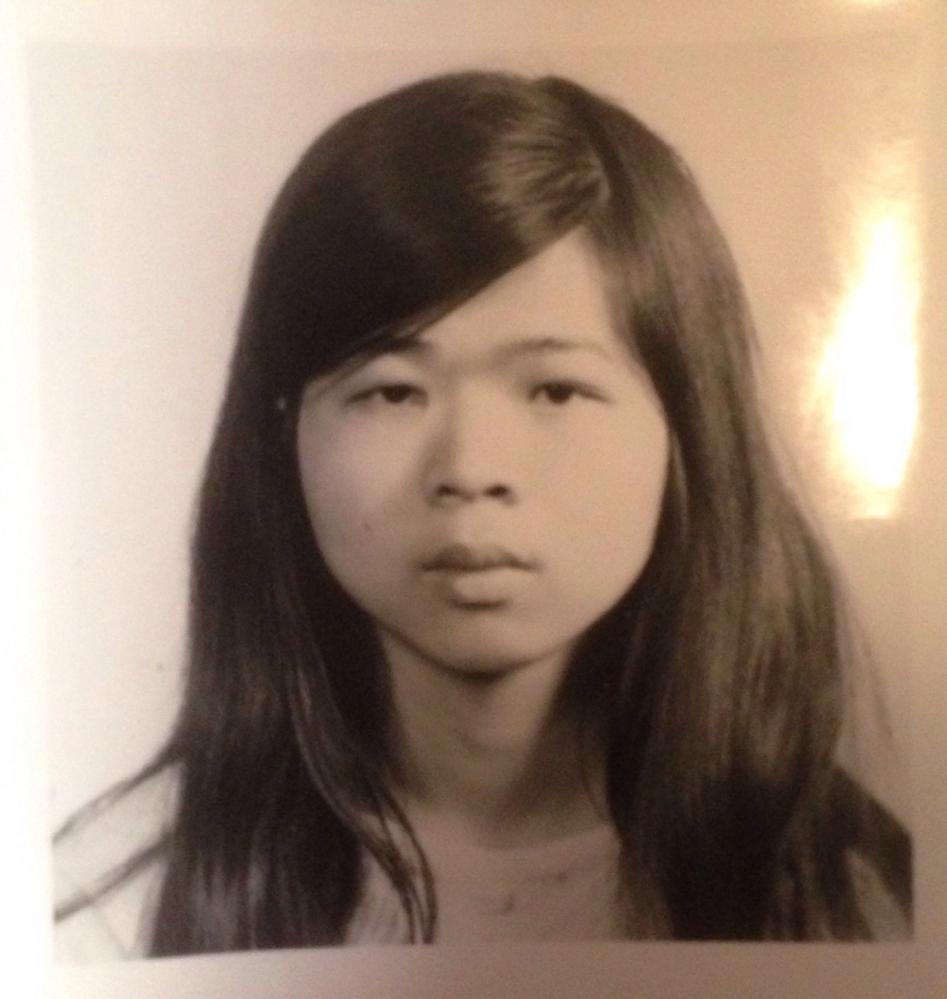
Before traveling to Taiwan last year, I knew only a few things about my birth mother Susie (her American name). She was born in 1950 and grew up in Tainan in the southwest of Taiwan. In the 1970s, she immigrated to Las Vegas, and she worked briefly as a card dealer at a casino. While visiting Taipei in 1980, she met an engineer on a British ship; he would become my birth father. She gave birth to me in Las Vegas on April 9, 1981, and a few weeks later, she put me up for adoption.


bh_susie

Susie’s passport photo in 1975, when she was 25


In September 2012, my start-up 1000memories was acquired by Ancestry.com, setting off a chain of events that would lead me to Taiwan to look for Susie. Suddenly, family history was my full-time job, and I felt inspired to learn more about my birth mother. I petitioned the Family Court of Clark County, Nevada, to open my adoption records. The Court granted my request, revealing Susie’s last name.


Susie’s last name led me to her younger brother and sister in Las Vegas, whom I found by cold calling numbers in an online telephone directory. A DNA test verified our relationship. Susie’s siblings had lost touch with her in the 1980s, and they guessed that she had moved back to Taiwan. Her brother gave me a passport photo of her when she was 25 years old, as well as an immigration document with her name written in Chinese, her birth date, and Taiwanese identification number.


When I left Las Vegas, boarding the first of three flights for Taiwan, I had many questions. Was Susie still alive, and if so, was she in Taiwan? What did she do? Did she have a family? Why had she lost touch with her siblings? How would she and I feel if we met? What would happen afterward? I imagined many different stories and scenarios -  but not what was about to happen.


I arrived in Taipei at night on Wednesday, October 23. Within 24 hours, I hit a dead end. An official at the local government office in Taipei told me that Susie had left for the United States on March 25, 1981, two weeks before I was born. The Taiwanese government had no record of her ever returning.


I spent the next few days exploring Taipei, taking long runs to help recover from jet lag, and contemplating my next move. I called Susie’s siblings, but they didn’t know more than what they had already told me. I reached out to a few private investigators in Taiwan. They suggested I go on Taiwanese TV to tell my story (apparently, many Taiwanese-Americans have been reunited with lost family members this way). Disappointed, I wondered if it would be more fruitful for me to shift my search from Susie to my birth father Thomas Llewellyn Hughes—who, I suspect, remains in Asia if he’s still alive at 83.


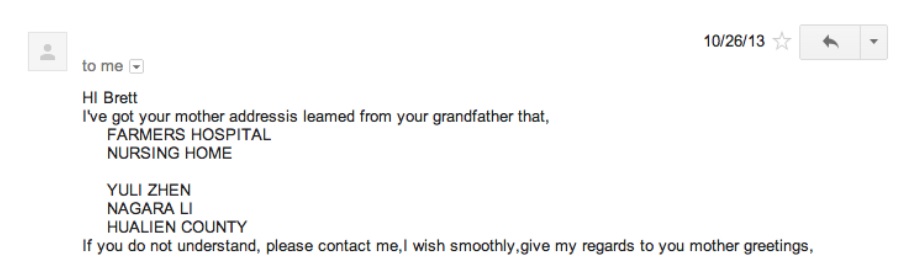
Then, on Sunday, I had a breakthrough. Susie’s oldest brother David called me. David also lives in Las Vegas, but we had not met because of an ongoing dispute between siblings. Despite barriers in communication (I do not speak Mandarin, and David has an accent and unique diction in English), I explained that I was in Taiwan looking for Susie. Within a couple hours, he emailed me an address in Hualien, a rural county on Taiwan’s remote eastern coast.


bh_email


I asked for help from the Westin Taipei’s concierge, a young woman named Alice. Without offerings details, I gave Alice the address, and told her I was looking for a woman named Susie born on May 3, 1950. Alice googled the address, called the number she found, and spoke for a few minutes in Mandarin with the person who answered. After hanging up, she turned to me and said:


They say there is a woman there named Susie. She is approximately the same age as the woman you are looking for, but they cannot confirm her birth date because they do not know what her birth date is. Are you sure this is the right place? I do not think this is the place you are looking for. It is called Farmers Hospital. It is for the homeless.


The next morning, Alice and I met at Taipei Main Station at 7 a.m. Alice, who had graduated from the University of San Francisco a few years earlier, offered to accompany me as a translator on her day off. On the four-hour train ride, Alice and I talked about life in San Francisco, and she taught me how to count from 1 to 10 in Mandarin.


Mostly, I wondered if the Susie I would meet that day would be my birth mother — and, if so, what it would be like to meet her. We traveled down the mountainous eastern coast of Taiwan, between the sea and the green mountains, past the municipal capital Hualian, past the Taroko Gorge where most passengers got off, past the rivers and rice fields of southern Hualien County, until eventually we arrived in the sleepy farming village of Yuli. I felt a little bit like Marlow in an idyllic version of Heart of Darkness: nervous and excited in a foreign land.


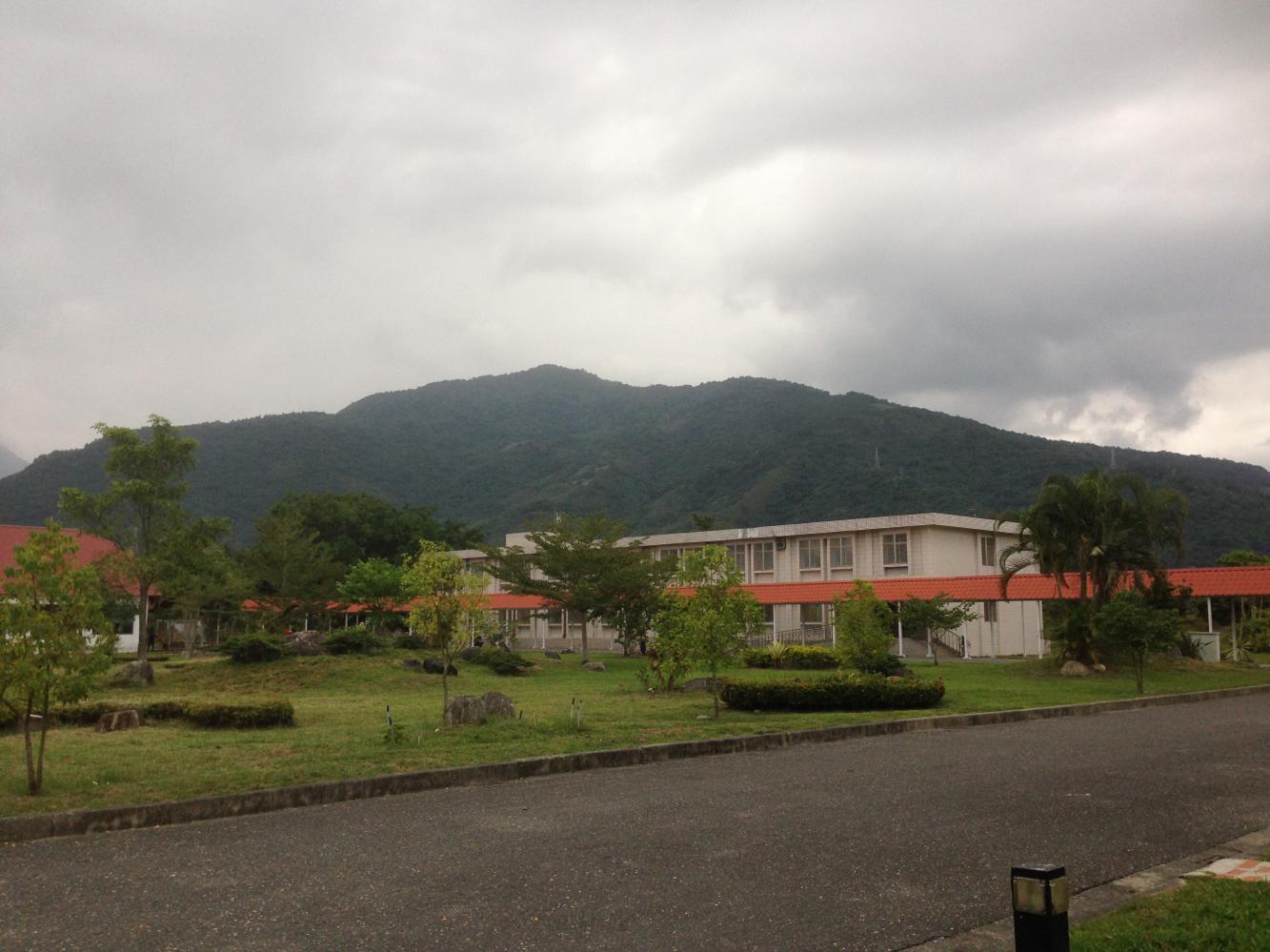
We took a 15-minute taxi from the train station to the hospital outside of town. I left my suitcase with the security guard out front.


bh_yuli


The women’s building at Farmers Hospital in Yuli


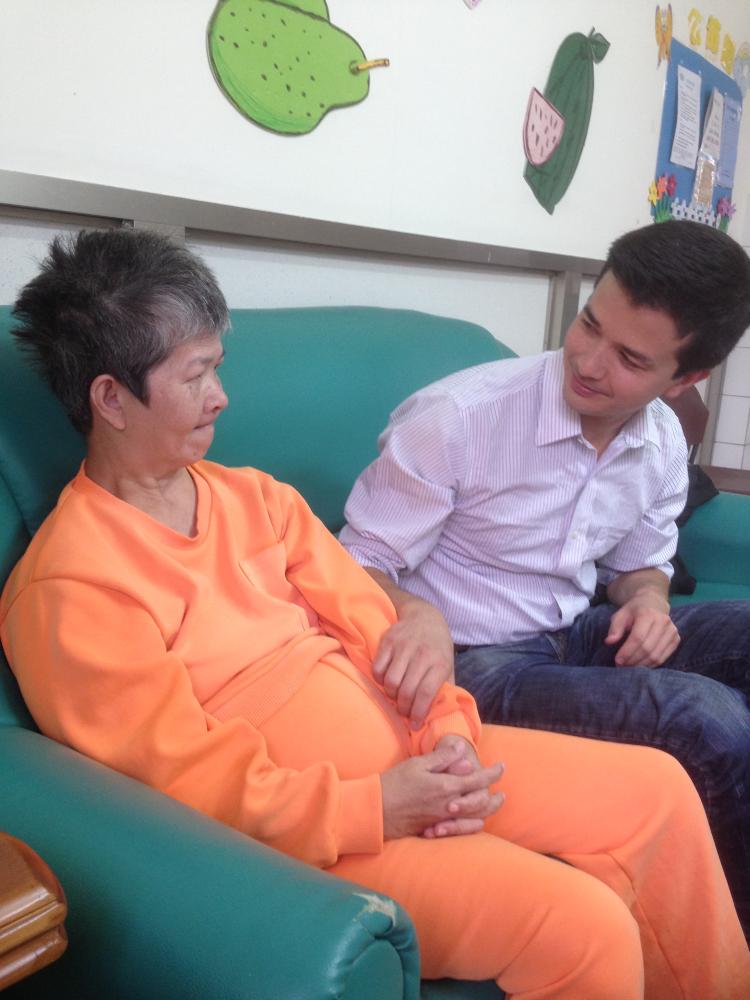
When we entered the women’s building of the hospital, Susie was standing in the middle of the TV room. There were perhaps 10 other women, whom the nurse quickly ushered out. All of them, including Susie, were wearing orange sweat suits. I noticed that Susie was short and chubby, and her black and white hair, cut short like a man’s, stuck up wildly in the back -  like mine does when I have bedhead.


“Hi,” I said. She smiled but didn’t say anything. The nurse explained through Alice that Susie is nearly deaf, and she can only hear if you shout Mandarin into her left ear.


We sat down on the green plastic couch, and we tried to have a conversation. Shouting into a 63-year-old stranger’s left ear felt awkward, so Alice and I “spoke” to Susie by writing Chinese characters on white sheets of paper. Susie read them and then responded with short, simple answers.


bh_sofa

Susie and I on the green plastic couch


I asked Susie how she was doing, and how long she had lived in the hospital. I asked her questions about her family, her children, and her past. Her memory was hazy, and she could only remember the vaguest of details. She didn’t know how long she had been there. Her father worked in the Air Force. She went to high school in Tainan. She had lived in Denver and Las Vegas a long time ago. She had two sons and also a daughter. She could not remember her daughter’s name.


Convinced by our physical resemblance and similarities in our stories, the nurse began to tell Susie that I was her son. Susie shook her head and waved her hand in disbelief. The nurse kept repeating in Susie’s left ear and pointing at me, “This is your son!” Susie could not and did not believe it.


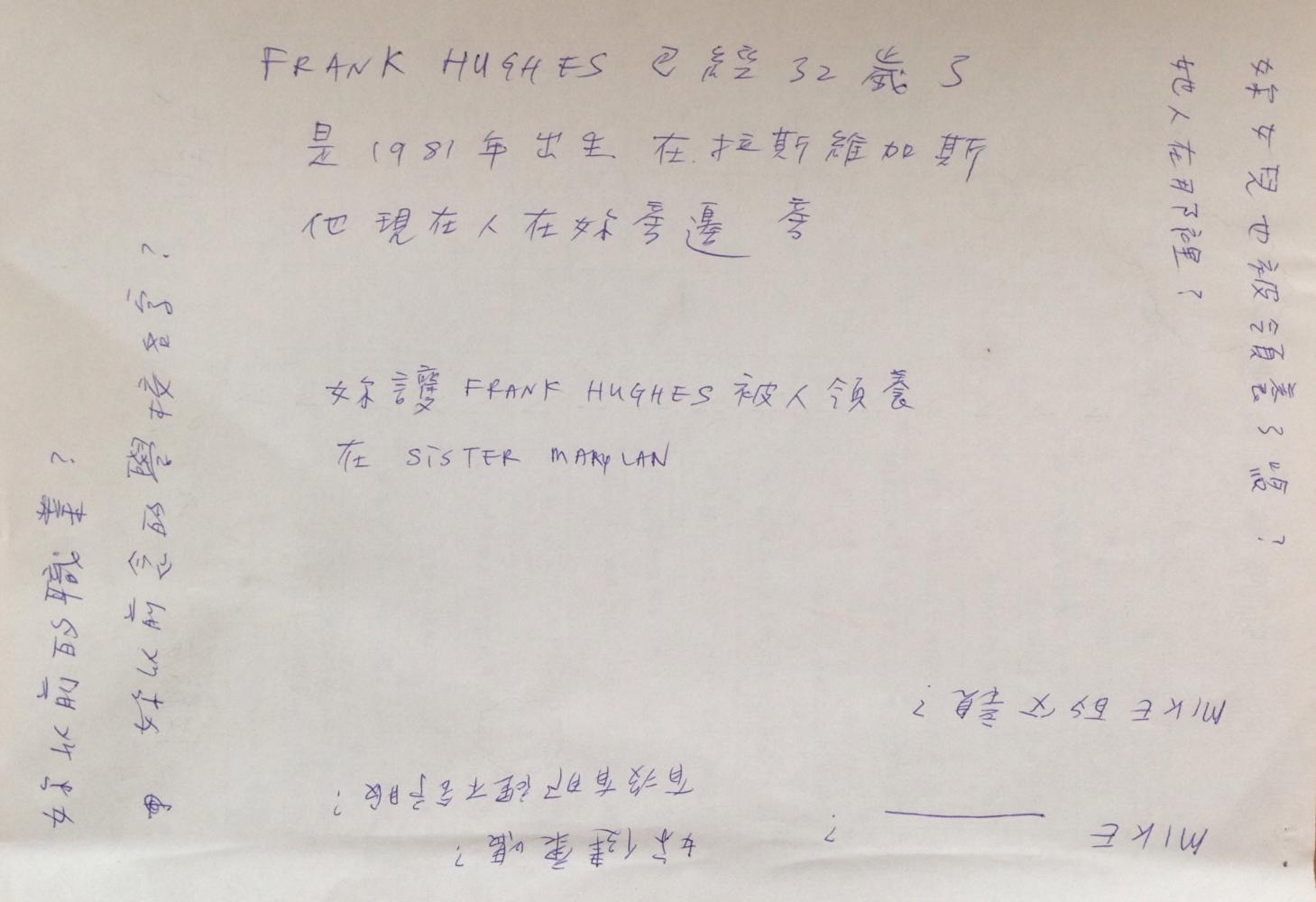
I wrote down on a sheet of paper in big capital letters, “FRANK HUGHES.” A few months earlier, I had learned from my original birth certificate that Frank Hughes was my original name. I showed the paper to Susie and pointed at the words.


bh_alice


One of the sheets of paper that Alice and I wrote on


“My son,” said Susie matter of factly. “Sì Jiǔ.”


Alice reminded me that Si Jiǔ means “four nine” in Mandarin. I realized that Susie called me Si Jiǔ to remember my birth date  - April 9.


“I am Frank Hughes. I am Sì Jiǔ. I was born on April 9, 1981, in Las Vegas.”


Susie grinned widely, almost as if I had embarrassed her. She shook her head and waved her hand, and then she turned to the nurse and said: “My son would not visit from the United States. Plus, he is too handsome to be my son.”


The next day, I returned to the hospital to visit Susie and meet her social worker Sui-Ching. Mei, the warm-hearted, 60-year-old proprietor of my B&B, replaced Alice as my translator.


The social worker showed us Susie’s medical records. “Schizophrenia” jumped out in English — no translation required.


According to Sui-Ching, Susie was in good physical health but suffered from mental illness. Her symptoms had improved over the years, and her hallucinations had become less severe and less frequent. Unlike some of her roommates, she could feed herself and dress herself.


“How long has she been here?” I asked.


Sui-Ching explained that Susie was picked up off the street and admitted to a sister hospital in Taipei as an “unknown person” more than 16 years ago, sometime during the 1980s or 1990s. In 1997, the hospital in Taipei burned down, and Susie was transferred to Yuli. Unfortunately, nothing else about her was known because all medical records were destroyed in the fire, and her attending physician had passed away.


I spent the rest of the week in Yuli, visiting Susie once a day. I tried to think of activities that would make our communication deficiencies less apparent. Susie made it easy. She smiled a lot, and she seemed genuinely pleased that a friendly stranger had come to visit from the United States.


bh_facetime

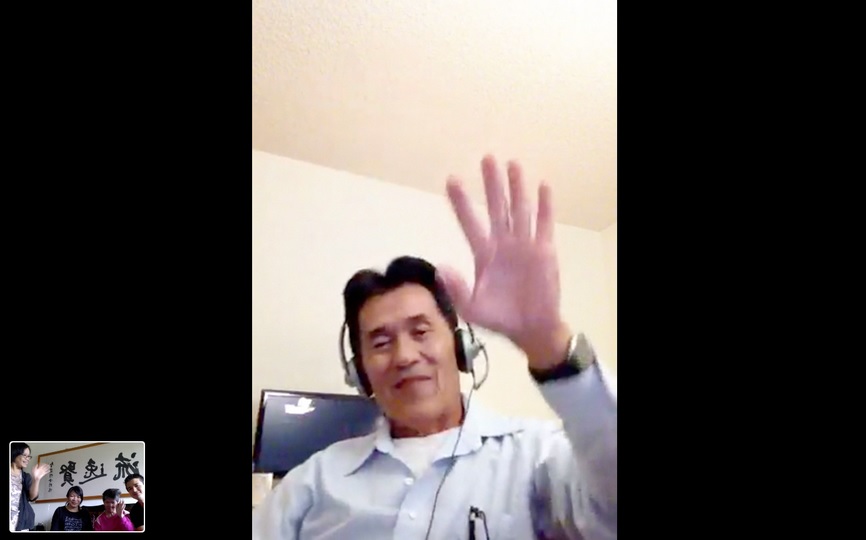
FaceTime with Mei, Sui-Ching, Susie, David, and me


We took walks around the peaceful grounds of the hospital. One day, her social worker and I took Susie to get her hearing checked at a clinic in Yuli. I wanted to buy her hearing aids, but Susie refused because they made the world too noisy. Another day, we used the internet connection at my B&B to make a FaceTime call to her older brother David. They hadn’t seen each other for 35 years. Susie didn’t recognize him at first, but after about 15 minutes, she understood who he was. She could not hear him, so she decided to write on a sheet of paper in Chinese, “I am happy,” and she showed it to him.


bh_polaroid

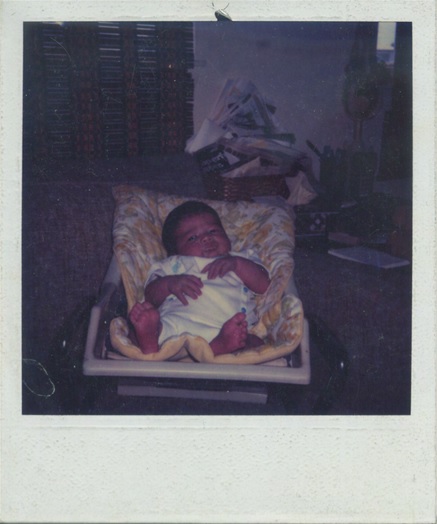
My first Polaroid


Each day, I showed her pictures on my MacBook Air of my evolution from baby, to boy, to adolescent, to adult, to the present day. I started with the first picture of me ever, a blurry Polaroid that Susie had taken herself when I was only a couple weeks old. I thought that through pictures, she might realize that I was her son. She never did.


At the end of the week, many questions remained unanswered. What triggered Susie’s schizophrenia and when? Did mental illness influence her decision to put me up for adoption? Why does the government have no record of her return to Taiwan? What happened to her in Taipei, and how did she end up on the street? Who and where are my half-brother and half-sister? Will I ever meet them or Thomas?


I wasn’t going to leave Yuli with these answers, but I did want to leave something behind for Susie. I wrote a short note, and Mei help me translate:


Your son Frank Hughes is very grateful to you for giving birth to him and for putting him up for adoption. He is now 32 years old and has had a very good life — loving family, great education, fulfilling career. He is happy and proud to be your son.


I also made copies of two photographs — the Polaroid of me as a baby, and a picture of us together from the visit. Sui-Ching laminated the letter and the photographs together so that Susie could keep them safe.


Maybe one day Susie will see the note and photos and realize who I am.


The author thanks Lauren Ladoceour, Beth Huneycutt, Ashley Huneycutt, Felicia Curcuru, and Rudy Adler for reading drafts of this memoir.


*


This article was originally published on Medium .